Reviewed 6 October 2026: material-report scope, certificate checks and additional-testing terms.
If you're fitting out a childcare centre or early-learning room in Australia and you've decided to go down the Montessori path, you've already made the most important call: an environment that respects how children actually learn, rather than one designed for adult convenience.
This guide covers what we've learned from over a decade of making children's furniture in our Xuzhou factory — what “Montessori” really means at the design level, the Australian standards you need to keep in mind, how to size shelves correctly, and what to verify before placing an order with any Chinese factory.
What Makes Furniture “Montessori”?
The Montessori method, developed by Dr. Maria Montessori in the early 1900s, is built on the idea that children learn best when their environment empowers them to act independently. That philosophy translates directly into furniture design — and it's why Montessori rooms tend to look so different from conventional childcare interiors.
Montessori-aligned furniture is characterised by:
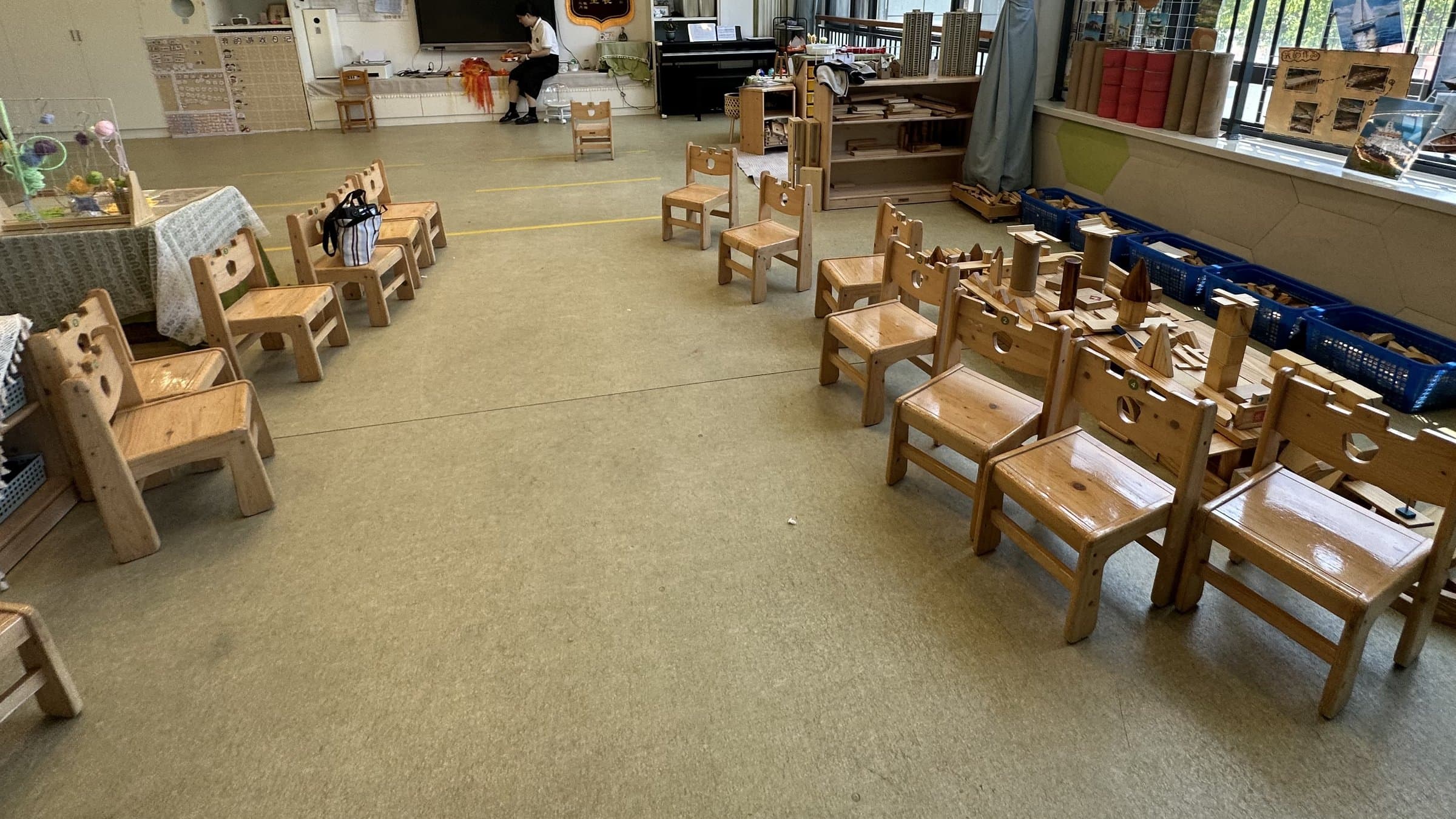
- Child-proportioned heights — shelves, tables, and chairs sized for the child, not the adult supervisor
- Open accessibility — no closed cupboards or doors that require an adult to open
- Natural materials — wood is preferred over plastic for its warmth, texture, and longevity
- Uncluttered surfaces — each item has a dedicated place, supporting the “prepared environment”
- Mobility — light enough that children can rearrange pieces themselves
Note that “Montessori-style” is a design philosophy, not a regulated certification mark. Any factory or seller can use the term. What matters in practice is whether the furniture behaves in line with these principles, and whether it meets the actual safety standards that govern childcare environments in Australia.
Australian Standards You Need to Know
If you're buying furniture for an approved childcare service in Australia, regulatory compliance is non-negotiable. The framework is layered:
ACCC Mandatory Product Safety Standards
The Australian Competition and Consumer Commission maintains the legally mandatory standards for many children's products. For furniture, the focus is on sharp edges, pinch points, structural failure, and tip-over risk. Always check the ACCC product safety website for current mandatory standards before purchasing.
Applicable AS/NZS Standards
A range of Australian/New Zealand Standards apply to children's and educational furniture, covering load capacity, structural integrity, finish safety, and tip-over prevention. Standards Australia is the authoritative source — buyers should confirm with their supplier which specific AS/NZS standard each product is rated against, and request the corresponding test report.
Tip-Over Prevention
This deserves a separate mention because it's one of the most consistently flagged safety issues in childcare-furniture audits. All freestanding shelving units intended for child-accessible rooms should ship with anti-tip wall anchors, and they need to be installed at fit-out time, not stored in a drawer.
Material reports and certificates
For a wholesale order, separate these document types:
- Panel emission evidence: check the test method, date, sample specification, result and applicable limit. A plywood sample report does not test the complete furniture or its finish.
- Supplier certification: check the certificate holder, current status, product and site scope, and the transaction records linking the claim to the quoted material.
- Structural material evidence: where a project specifies a structural plywood grade, request the relevant document for that panel. A board grade is separate from a furniture test.
- Timber sourcing records: FSC chain-of-custody claims and destination-market timber obligations require their own checks. A supplier certificate does not automatically make finished furniture FSC-certified.
The displayed MJK report is a 31 March 2026 SHST ASTM D6007-22 result for uncoated 18 mm, 13-ply HWPW-VC samples, with the wood species listed as birch. Its 0.039 ppm average is compared with a 0.05 ppm limit. Confirm the report's applicability to the quoted panel and material batch; it does not establish an E0 or E1 grade.
Choosing the Right Shelf Heights
One of the most common mistakes in childcare fit-outs is selecting shelves that are too tall — they end up being adult storage with a child-friendly label. Here's a practical guide:
| Age Group | Recommended Shelf Height |
|---|---|
| 0–2 years | 400–500 mm (floor level) |
| 2–3 years | 500–600 mm |
| 3–4 years | 600–700 mm |
| 4–6 years | 700–800 mm |
For open shelving intended for direct child access, a maximum height of 600 mm in toddler rooms and 800 mm in preschool rooms is a reasonable rule of thumb. If shelves are taller than that, only the bottom two shelves should hold child-accessible materials; everything above becomes adult-managed storage.
What to Look for When Importing from China
Sourcing furniture from China can deliver significant cost savings — a comparable piece from a Chinese factory often costs 40–60% less than an equivalent locally manufactured product. But “cheaper” only matters if the goods actually arrive, pass customs, and meet the standards your auditor will check. Here's what to verify before placing an order:
1. Test reports, not just certificates
Ask for the available report and check the issuer, date, sample or product model, method and results. Verify the report with the issuing laboratory and match it to your order. For additional testing, agree the product scope, laboratory, sample and lot identification, report addressee, cost and timing in the quotation.
2. Timber species and moisture content
For structural pieces, solid hardwood or quality plywood beats MDF and particleboard for durability and screw-holding capacity. Our solid components are made from beech; for plywood cabinetry, confirm the panel specification and applicable emission evidence rather than assuming a grade from a different test method. For furniture shipped to Australia’s drier inland climate, kiln-dried timber at 8–12% moisture content prevents warping and joint failure after delivery.
3. Finish and VOC levels
Water-based paints and lacquers carry significantly lower VOC (volatile organic compound) levels than solvent-based alternatives. Ask for the MSDS (Material Safety Data Sheet) of the specific finishes used on your order, and confirm whether they’re suited to children’s environments. Most reputable factories can provide this on request.
4. Anti-tip hardware included as standard
This is a small line item but non-negotiable. Verify in writing that wall anchors are bundled with every applicable shelving unit, not sold separately.
5. Sample first, then volume
For a first order with any factory, request a sample. Yes, it costs you the international shipping. But a $30 shipping bill is the cheapest insurance you'll ever buy on a $20,000 furniture order. A factory that resists sampling is telling you something.
The Cost of Getting It Wrong
Industry-side reporting and ACCC compliance audits consistently surface the same outcomes when childcare centres furnish on the cheapest possible quote:
- Compliance auditors can issue improvement notices or, in serious cases, suspend operations until the room is brought up to standard
- Insurance claims may be challenged or voided if injury occurs from non-compliant equipment
- Replacing furniture mid-fit-out roughly doubles cost and disruption — you pay for new pieces and lose room utilisation while they’re swapped in
The economics rarely work out in favour of the cheapest quote.
About MJK Furniture
MJK Furniture is a 3,000 m² children's furniture factory in Xuzhou, Jiangsu, China. We've been making children's furniture for the Chinese domestic market since 2015 — over 70,000 children's bookshelves shipped to Chinese parents and small retailers in that time — and in 2025 we developed sourcing for the Australian market. For wholesale orders, we review the selected material documents and any additional testing requirements with the buyer.
We don't claim to be the largest supplier or to have a long Australian client list yet — we don't. What we offer is direct, owner-led communication (Evan replies to every inquiry personally, usually within 30 minutes during China business hours), a 50-unit OEM MOQ, and a willingness to put in the extra effort that early customer relationships need.
If you're fitting out a Montessori-aligned room and want to talk through specs, certifications, or pricing — send a brief and Evan will get back to you in person.