Wooden Classroom Tables & Chairs
Height-adjustable activity tables and sturdy stackable chairs — with model-specific testing requirements reviewed before quotation.
Individual model pages
Compare models and specifications
Each page has a stable URL for buyer review, internal linking and search indexing.
MJK-TB-301
Montessori Solid Wood Rectangular Table
120 × 60 × 40 / 45 / 50 / 55 cm
MJK-TB-302
Montessori Solid Wood Square Table
60 × 60 × 40 / 45 / 50 / 55 cm
MJK-TB-303
Montessori Solid Wood Trapezoidal Table
120 cm long edge / 60 cm short edge; heights 40 / 45 / 50 / 55 cm
MJK-TB-304
Montessori Solid Wood Round Table
60 cm diameter; heights 40 / 45 / 50 / 55 cm
MJK-TB-305
Montessori Solid Wood Horseshoe Table
180 × 86 × 65 cm
MJK-CH-401
Classic Solid Beech Children’s Chair
28 × 30 × 51 cm
Solid Beech
Edge-glued solid beech tops, 18 or 20 mm. No MDF, no veneer.
Four Heights
Four heights 40 / 45 / 50 / 55 cm, matched to age. Custom on request.
Rounded Safety Edges
R30 radius or larger on every child-contact edge, fully sanded.
Testing Scope
Confirm applicable tests for the model and destination market.
Agree the testing scope for the selected model and destination market
Ask which reports are available and confirm any additional testing, laboratory, sample, cost and timing before quotation.
Tables and chairs in a China classroom
See MJK-CH-401 chairs and MJK-TB-301 tables in a real Montessori classroom in China. Use the footage alongside the model specifications when reviewing a range for resale or project supply.
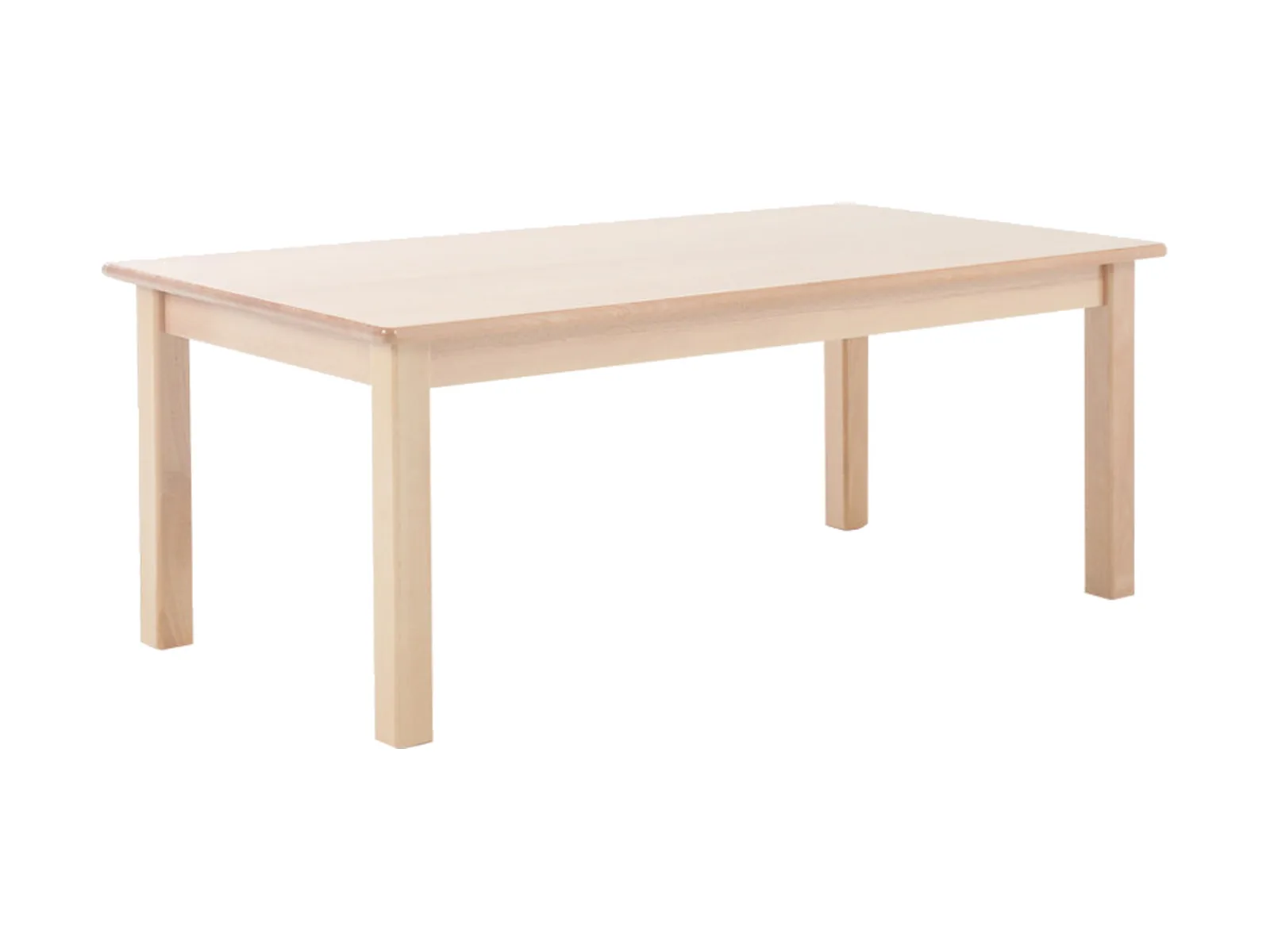
Model MJK-TB-301
Montessori Solid Wood Rectangular Table
120 × 60 cm top · solid beech · heights 40 / 45 / 50 / 55 cm
Detailed Description
- Dimensions.
- 120 × 60 cm top, available in four heights: 40 / 45 / 50 / 55 cm (confirm the selected height — see FAQ Q3).
- Material.
- Solid beech (Fagus species), 100 mm board width, edge-glued straight-jointed top. Two tabletop thickness options at order — 18 mm or 20 mm.
- Construction.
- CNC-machined top and legs. Leg-to-top joinery uses threaded inserts and machine bolts. Confirm the assembly instructions and any requirements for repeated dismantling before ordering.
- Finish.
- Choice of natural beeswax or water-based lacquer, both food-contact safe. Unfinished raw available on case-by-case request.
- Safety.
- 30 mm radius (R30) or larger on all child-contact corners and edges, fully sanded — consistent across the MJK range.
- Packaging.
- Five-layer corrugated carton with EPS edge frames and EPE foam between panels; shipped as individual cartons, no pallets by default.
- Customisation.
- Any custom height per order. Custom leg profile and custom edge radius also available. Minimum custom OEM run: 50 units per height.
- Pairing.
- Offered with the MJK-CH-401 Classic Wooden Chair as the MJK-SET-501 Rectangular Table & 2 Chairs Set. Confirm the selected table and seat heights together.
- Compliance reference.
- The plywood sample report does not establish emissions or compliance for a solid-beech table. For the report and its material scope, see Materials & Certification. Before quotation, confirm the model, destination market, applicable tests, laboratory, sample, report addressee, cost and timing.
Product FAQ
Q1. How does solid beech compare to MDF or particle-board kids' tables?
Three concrete differences. Load: solid beech meaningfully outperforms MDF in both static and dynamic bending strength — specific values supplied per spec request. Emissions: Assess the selected timber, adhesive and finish together; a plywood sample result does not establish emissions from a solid-beech table. Field life: a beech top sands and refinishes for the life of the table; an MDF top de-laminates when wet. The premium feel is real, but on a B2B procurement scorecard the load and longevity numbers are the argument.
Q2. Can you supply bespoke heights outside the 40 / 45 / 50 / 55 cm standard?
Yes — any custom height per order. Minimum: 50 units per height. We supply child-development sizing guidance for non-standard heights on request; what we don't do is recommend a height we haven't seen used in classroom practice.
Q3. How should buyers select a standard table height?
Standard table heights are 40, 45, 50 and 55 cm. Select the table and chair as a pair using the end users' measured dimensions, the intended activity and the requirements of the destination market. Age alone does not confirm fit. Confirm the selected seat and tabletop heights in the order specification; custom heights can be reviewed on quotation.
Q4. How is the table packed for flat-pack shipping?
Tabletop face-down in the carton, the four legs nested alongside in EPE foam corner protection — single carton, single SKU per carton. The buyer assembles on site with the supplied threaded inserts and machine bolts. If repeated dismantling and reassembly are required, confirm the applicable assembly instructions and model-specific evidence before ordering.
Q5. Where is the beech sourced?
Solid beech is supplied by regional mills near our workshop; the second-stage edge-glue jointing is performed in-house. Ask which supplier and material-lot records are available for the quotation. If FSC-certified material is required, confirm the current certificate holder, scope and transaction documents for the selected supply.
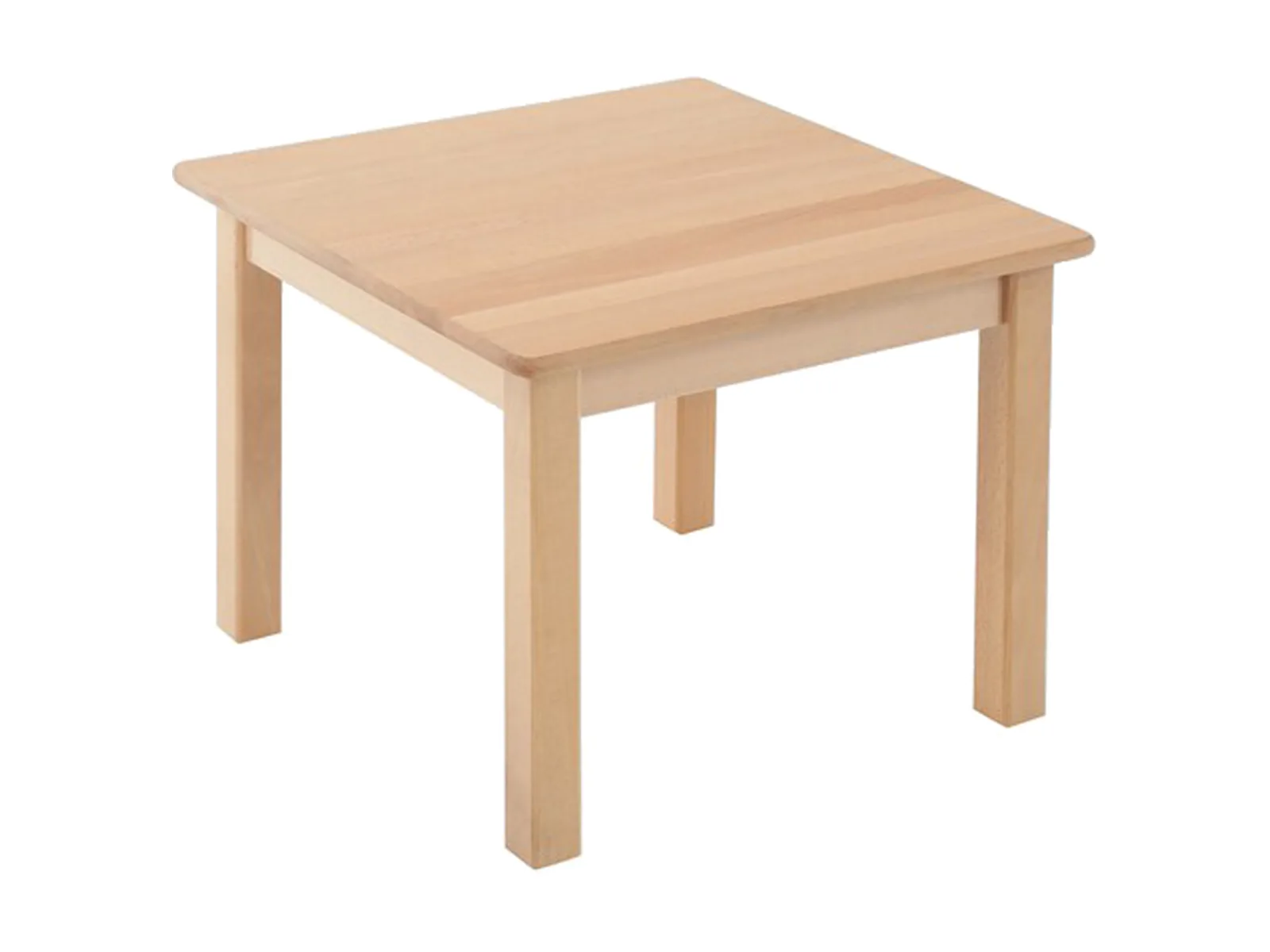
Model MJK-TB-302
Montessori Solid Wood Square Table
60 × 60 cm top · solid beech · heights 40 / 45 / 50 / 55 cm
Detailed Description
- Dimensions.
- 60 × 60 cm top, available in four heights: 40 / 45 / 50 / 55 cm (confirm the selected height — see FAQ Q4). Approx. 10 kg net.
- Material.
- Solid beech (Fagus species), edge-glued straight-jointed top. Three tabletop thickness options at order — 1.8 cm, 2.0 cm, or 2.5 cm (1.8 cm default).
- Construction.
- CNC-machined top and legs. Leg-to-top joinery uses threaded inserts and machine bolts. Confirm the assembly instructions and any requirements for repeated dismantling before ordering.
- Finish.
- Hardwax oil or sprayed clear lacquer, buyer's choice — both meet children's furniture surface safety standards. Unfinished raw available on case-by-case request.
- Safety.
- 30 mm radius (R30) or larger on all child-contact corners and edges, fully sanded — consistent across the MJK range.
- Packaging.
- Five-layer corrugated carton with EPS edge frames and EPE foam between panels; shipped as individual cartons, no pallets by default.
- Customisation.
- Any custom height per order. Custom leg profile and custom edge radius also available. Minimum custom OEM run: 50 units per height.
- Pairing.
- Can be ordered with the MJK-CH-401 Classic Wooden Chair. Confirm the selected table and seat heights together.
- Compliance reference.
- The plywood sample report does not establish emissions or compliance for a solid-beech table. For the report and its material scope, see Materials & Certification. Before quotation, confirm the model, destination market, applicable tests, laboratory, sample, report addressee, cost and timing.
Product FAQ
Q1. How does solid beech compare to MDF or particle-board kids' tables?
Three concrete differences. Load: solid beech meaningfully outperforms MDF in both static and dynamic bending strength — specific values supplied per spec request. Emissions: Assess the selected timber, adhesive and finish together; a plywood sample result does not establish emissions from a solid-beech table. Field life: a beech top sands and refinishes for the life of the table; an MDF top de-laminates when wet. The premium feel is real, but on a B2B procurement scorecard the load and longevity numbers are the argument.
Q2. The solid wood top is edge-glued from narrower boards — is there a formaldehyde concern at the joints?
The solid beech top is edge-glued from narrower boards, with water-based glue at the board-to-board seams. The plywood sample report HJ-QAT-260457 does not establish emissions from this solid-wood tabletop, its adhesive or its finish. Before quotation, confirm the model, destination market, applicable tests, laboratory, sample, report addressee, cost and timing.
Q3. Can you supply bespoke heights outside the 40 / 45 / 50 / 55 cm standard?
Yes — any custom height per order. Minimum: 50 units per height. We supply child-development sizing guidance for non-standard heights on request; what we don't do is recommend a height we haven't seen used in classroom practice.
Q4. How should buyers select a standard table height?
Standard table heights are 40, 45, 50 and 55 cm. Select the table and chair as a pair using the end users' measured dimensions, the intended activity and the requirements of the destination market. Age alone does not confirm fit. Confirm the selected seat and tabletop heights in the order specification; custom heights can be reviewed on quotation.
Q5. How is the table packed for flat-pack shipping?
Tabletop face-down in the carton, the four legs nested alongside in EPE foam corner protection — single carton, single SKU per carton. The buyer assembles on site with the supplied threaded inserts and machine bolts. If repeated dismantling and reassembly are required, confirm the applicable assembly instructions and model-specific evidence before ordering.
Q6. Where is the beech sourced?
Solid beech is supplied by regional mills near our workshop; the second-stage edge-glue jointing is performed in-house. Ask which supplier and material-lot records are available for the quotation. If FSC-certified material is required, confirm the current certificate holder, scope and transaction documents for the selected supply.
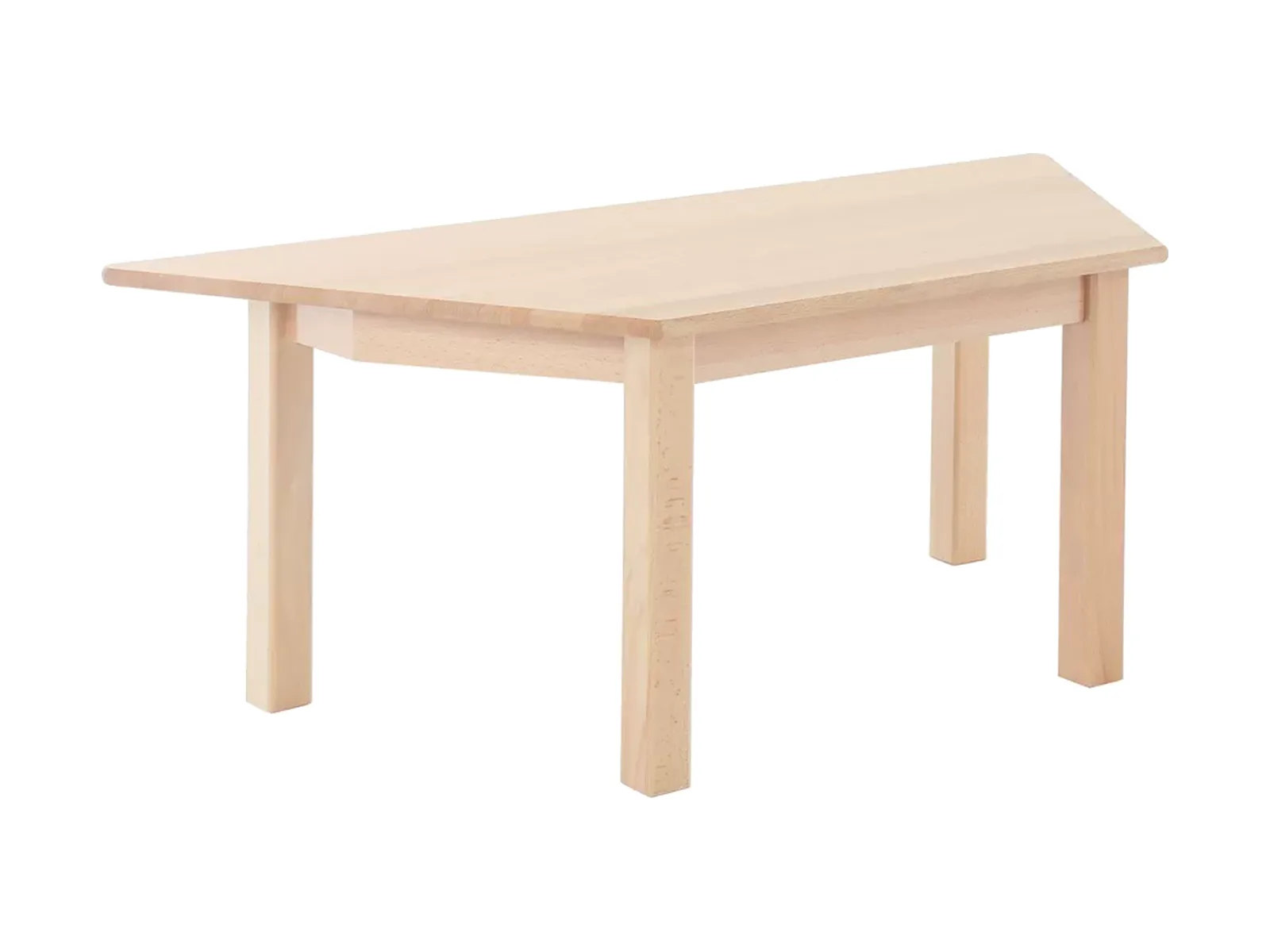
Model MJK-TB-303
Montessori Solid Wood Trapezoidal Table
120 cm long edge / 60 cm short edge · solid beech · heights 40 / 45 / 50 / 55 cm
Detailed Description
- Dimensions.
- Trapezoidal top — 120 cm long edge, 60 cm short edge (depth per spec sheet). Available in four heights: 40 / 45 / 50 / 55 cm (confirm the selected height — see FAQ Q4).
- Form.
- Half-hexagon trapezoid (120 cm : 60 cm = 2:1). Two units form a regular hexagon; several cluster into flexible small-group and group-work layouts — a Montessori and early-learning classroom staple. Four legs.
- Material.
- Solid beech (Fagus species), edge-glued straight-jointed top. Three tabletop thickness options at order — 1.8 cm, 2.0 cm, or 2.5 cm (1.8 cm default).
- Construction.
- CNC-machined top and legs. Leg-to-top joinery uses threaded inserts and machine bolts. Confirm the assembly instructions and any requirements for repeated dismantling before ordering.
- Finish.
- Hardwax oil or sprayed clear lacquer, buyer's choice — both meet children's furniture surface safety standards. Unfinished raw available on case-by-case request.
- Safety.
- 30 mm radius (R30) or larger on all child-contact corners and edges, fully sanded — consistent across the MJK range.
- Packaging.
- Five-layer corrugated carton with EPS edge frames and EPE foam between panels; shipped as individual cartons, no pallets by default.
- Customisation.
- Any custom height per order. Custom leg profile and custom edge radius also available. Minimum custom OEM run: 50 units per height.
- Pairing.
- Can be ordered with the MJK-CH-401 Classic Wooden Chair. Confirm the selected table and seat heights together.
- Compliance reference.
- The plywood sample report does not establish emissions or compliance for a solid-beech table. For the report and its material scope, see Materials & Certification. Before quotation, confirm the model, destination market, applicable tests, laboratory, sample, report addressee, cost and timing.
Product FAQ
Q1. How does solid beech compare to MDF or particle-board kids' tables?
Three concrete differences. Load: solid beech meaningfully outperforms MDF in both static and dynamic bending strength — specific values supplied per spec request. Emissions: Assess the selected timber, adhesive and finish together; a plywood sample result does not establish emissions from a solid-beech table. Field life: a beech top sands and refinishes for the life of the table; an MDF top de-laminates when wet. The premium feel is real, but on a B2B procurement scorecard the load and longevity numbers are the argument.
Q2. The solid wood top is edge-glued from narrower boards — is there a formaldehyde concern at the joints?
The solid beech top is edge-glued from narrower boards, with water-based glue at the board-to-board seams. The plywood sample report HJ-QAT-260457 does not establish emissions from this solid-wood tabletop, its adhesive or its finish. Before quotation, confirm the model, destination market, applicable tests, laboratory, sample, report addressee, cost and timing.
Q3. Can the trapezoidal tables be combined into larger layouts?
Yes — that is the point of the trapezoidal shape. The 120 cm long edge to 60 cm short edge is a 2:1 half-hexagon proportion: two units form a regular hexagon, and several cluster into flexible small-group and group-work layouts. This is a Montessori and early-learning classroom staple for reconfigurable seating.
Q4. How should buyers select a standard table height?
Standard table heights are 40, 45, 50 and 55 cm. Select the table and chair as a pair using the end users' measured dimensions, the intended activity and the requirements of the destination market. Age alone does not confirm fit. Confirm the selected seat and tabletop heights in the order specification; custom heights can be reviewed on quotation.
Q5. How is the table packed for flat-pack shipping?
Tabletop face-down in the carton, the four legs nested alongside in EPE foam corner protection — single carton, single SKU per carton. The buyer assembles on site with the supplied threaded inserts and machine bolts. If repeated dismantling and reassembly are required, confirm the applicable assembly instructions and model-specific evidence before ordering.
Q6. Where is the beech sourced?
Solid beech is supplied by regional mills near our workshop; the second-stage edge-glue jointing is performed in-house. Ask which supplier and material-lot records are available for the quotation. If FSC-certified material is required, confirm the current certificate holder, scope and transaction documents for the selected supply.
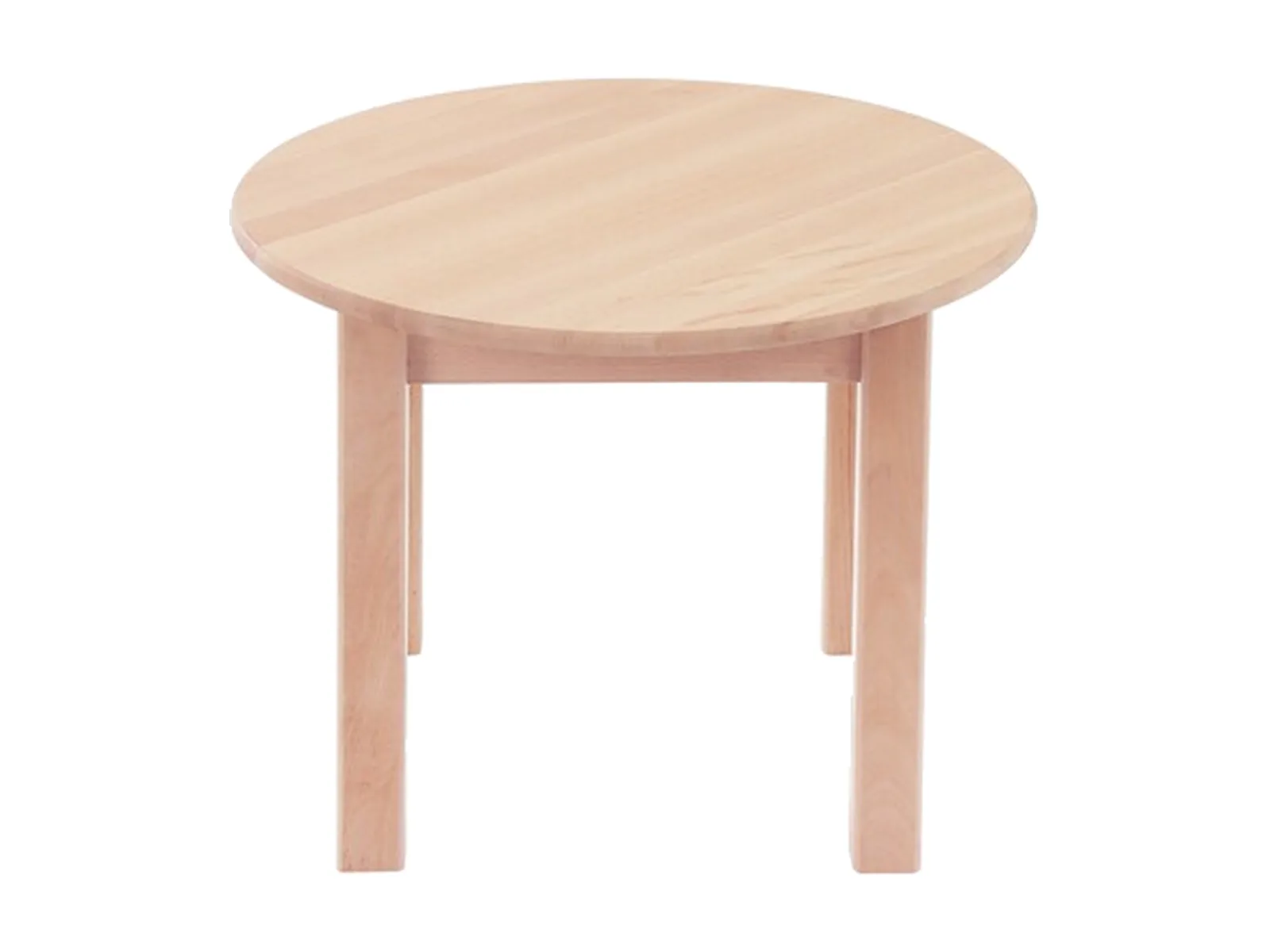
Model MJK-TB-304
Montessori Solid Wood Round Table
60 cm diameter round top · solid beech · heights 40 / 45 / 50 / 55 cm
Detailed Description
- Dimensions.
- 60 cm diameter round top, available in four heights: 40 / 45 / 50 / 55 cm (confirm the selected height — see FAQ Q4). Four legs.
- Material.
- Solid beech (Fagus species), edge-glued top cut to a circular profile. Three tabletop thickness options at order — 1.8 cm, 2.0 cm, or 2.5 cm (1.8 cm default).
- Construction.
- CNC-machined top and legs. Leg-to-top joinery uses threaded inserts and machine bolts. Confirm the assembly instructions and any requirements for repeated dismantling before ordering.
- Finish.
- Hardwax oil or sprayed clear lacquer, buyer's choice — both meet children's furniture surface safety standards. Unfinished raw available on case-by-case request.
- Safety.
- Continuous rounded edge with no corners by design; edge fully sanded to a smooth radius — consistent across the MJK range.
- Packaging.
- Five-layer corrugated carton with EPS edge frames and EPE foam between panels; shipped as individual cartons, no pallets by default.
- Customisation.
- Any custom height per order. Custom diameter and custom edge radius also available. Minimum custom OEM run: 50 units per height.
- Pairing.
- Can be ordered with the MJK-CH-401 Classic Wooden Chair. Confirm the selected table and seat heights together.
- Compliance reference.
- The plywood sample report does not establish emissions or compliance for a solid-beech table. For the report and its material scope, see Materials & Certification. Before quotation, confirm the model, destination market, applicable tests, laboratory, sample, report addressee, cost and timing.
Product FAQ
Q1. How does solid beech compare to MDF or particle-board kids' tables?
Three concrete differences. Load: solid beech meaningfully outperforms MDF in both static and dynamic bending strength — specific values supplied per spec request. Emissions: Assess the selected timber, adhesive and finish together; a plywood sample result does not establish emissions from a solid-beech table. Field life: a beech top sands and refinishes for the life of the table; an MDF top de-laminates when wet. The premium feel is real, but on a B2B procurement scorecard the load and longevity numbers are the argument.
Q2. The solid wood top is edge-glued from narrower boards — is there a formaldehyde concern at the joints?
The solid beech top is edge-glued from narrower boards, with water-based glue at the board-to-board seams. The plywood sample report HJ-QAT-260457 does not establish emissions from this solid-wood tabletop, its adhesive or its finish. Before quotation, confirm the model, destination market, applicable tests, laboratory, sample, report addressee, cost and timing.
Q3. Does the round table have any corners?
No — the round top has a continuous edge with no corners by design, which removes corner-impact points entirely. The edge is fully sanded to a smooth radius. The round form also suits circle-time and small-group activities where every child has an equal sightline.
Q4. How should buyers select a standard table height?
Standard table heights are 40, 45, 50 and 55 cm. Select the table and chair as a pair using the end users' measured dimensions, the intended activity and the requirements of the destination market. Age alone does not confirm fit. Confirm the selected seat and tabletop heights in the order specification; custom heights can be reviewed on quotation.
Q5. How is the table packed for flat-pack shipping?
Tabletop face-down in the carton, the four legs nested alongside in EPE foam corner protection — single carton, single SKU per carton. The buyer assembles on site with the supplied threaded inserts and machine bolts. If repeated dismantling and reassembly are required, confirm the applicable assembly instructions and model-specific evidence before ordering.
Q6. Where is the beech sourced?
Solid beech is supplied by regional mills near our workshop; the second-stage edge-glue jointing is performed in-house. Ask which supplier and material-lot records are available for the quotation. If FSC-certified material is required, confirm the current certificate holder, scope and transaction documents for the selected supply.
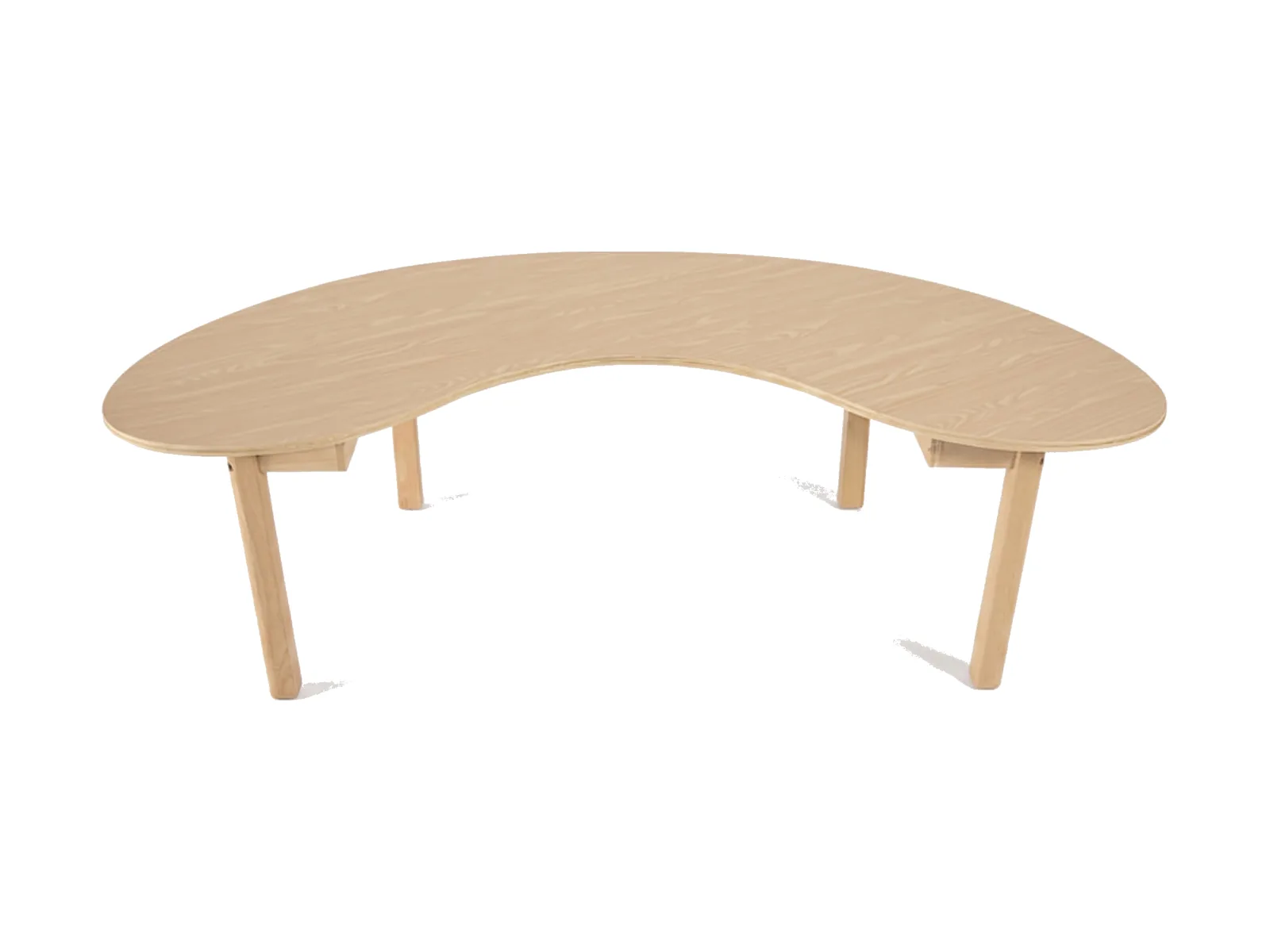
Model MJK-TB-305
Solid Wood Horseshoe Table (Moon Table)
180 × 86 cm · height 65 cm (customisable) · solid beech
Detailed Description
- Dimensions.
- 180 × 86 cm horseshoe (curved) top, standard height 65 cm (customisable per order). Approx. 32 kg net.
- Form.
- Horseshoe (curved, U-shaped) layout — children are seated along the inner curve, the teacher works from the outer side. Seating capacity is not measured or stated; fit is determined by on-site dimensions and the institution's own spacing requirements.
- Material.
- Solid beech (Fagus species), edge-glued straight-jointed top.
- Construction.
- CNC-machined top and legs. Leg-to-top joinery uses threaded inserts and machine bolts. Confirm the assembly instructions and any requirements for repeated dismantling before ordering.
- Finish.
- Hardwax oil or sprayed clear lacquer, buyer's choice — both meet children's furniture surface safety standards. Unfinished raw available on case-by-case request.
- Safety.
- 30 mm radius (R30) or larger on all child-contact corners and edges, fully sanded — consistent across the MJK range.
- Packaging.
- Five-layer corrugated carton with EPS edge frames and EPE foam between panels; shipped as individual cartons, no pallets by default.
- Customisation.
- Height customisable per order. Custom edge radius also available. Minimum custom OEM run: 50 units.
- Pairing.
- Can be ordered with the MJK-CH-401 Classic Wooden Chair for seating along the inner curve. Confirm the selected table and seat heights together.
- Compliance reference.
- The plywood sample report does not establish emissions or compliance for a solid-beech table. For the report and its material scope, see Materials & Certification. Before quotation, confirm the model, destination market, applicable tests, laboratory, sample, report addressee, cost and timing.
Product FAQ
Q1. How does solid beech compare to MDF or particle-board kids' tables?
Three concrete differences. Load: solid beech meaningfully outperforms MDF in both static and dynamic bending strength — specific values supplied per spec request. Emissions: Assess the selected timber, adhesive and finish together; a plywood sample result does not establish emissions from a solid-beech table. Field life: a beech top sands and refinishes for the life of the table; an MDF top de-laminates when wet. The premium feel is real, but on a B2B procurement scorecard the load and longevity numbers are the argument.
Q2. The solid wood top is edge-glued from narrower boards — is there a formaldehyde concern at the joints?
The solid beech top is edge-glued from narrower boards, with water-based glue at the board-to-board seams. The plywood sample report HJ-QAT-260457 does not establish emissions from this solid-wood tabletop, its adhesive or its finish. Before quotation, confirm the model, destination market, applicable tests, laboratory, sample, report addressee, cost and timing.
Q3. Can the height be customised?
Yes. The horseshoe table ships at a standard 65 cm height and can be built to any custom height per order — minimum 50 units. Because this is a group / collaborative table rather than an individual work table, height is typically matched to the chair height your classroom already uses; we supply seat-to-tabletop clearance guidance on request.
Q4. How is the table packed for flat-pack shipping?
The buyer assembles on site with the supplied threaded inserts and machine bolts. Standard export packing is a five-layer corrugated carton (seven-layer available on request) with rigid EPS foam edge frames and EPE foam sheets between every two panels. Orders ship as individually packed cartons without pallets by default; palletised loading can be quoted on request, with destination wood-packaging requirements handled at that point.
Q5. Where is the beech sourced?
Solid beech is supplied by regional mills near our workshop; the second-stage edge-glue jointing is performed in-house. Ask which supplier and material-lot records are available for the quotation. If FSC-certified material is required, confirm the current certificate holder, scope and transaction documents for the selected supply.
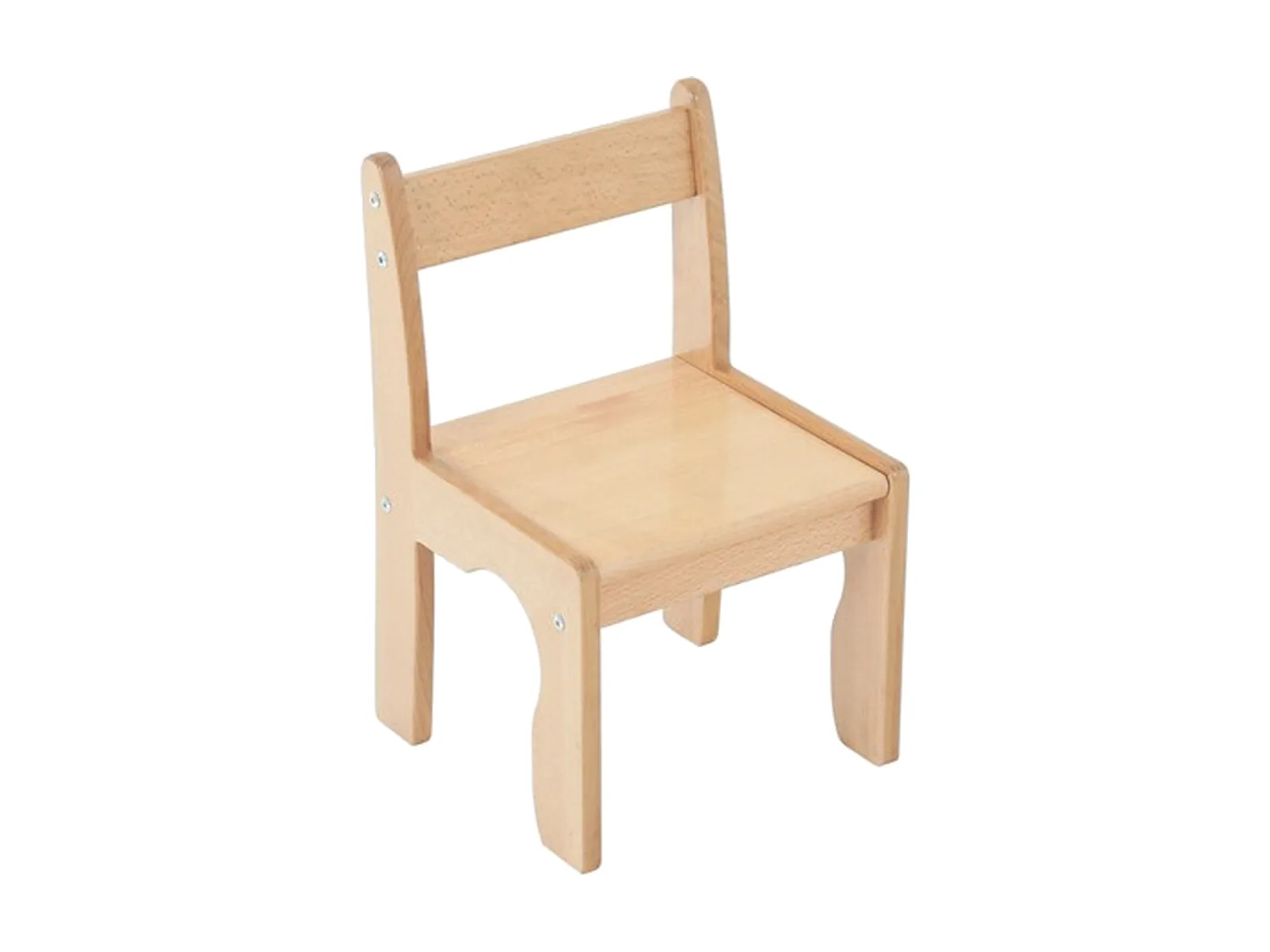
Model MJK-CH-401
Classic Wooden Chair (Companion to MJK-TB-301)
28 × 30 × 51 cm · solid European beech · seat heights 26 / 28 / 30 / 32 cm · stackable
| Field | Value |
|---|---|
| Model | MJK-CH-401 |
| Dimensions | 28 × 30 × 51 cm (W × D × total H) |
| Material | Solid European beech (no plywood, no MDF) |
| Surface finish | Hardwax oil OR sprayed clear lacquer (buyer's choice) |
| Leg count | 4 (curved/shaped silhouette) |
| Stretchers | 1 front + 1 rear (no side stretchers) |
| Seat panel | Flat, 18 mm solid beech |
| Backrest | Single horizontal rail |
| Backrest angle | 95 degrees from seat plane (5-degree rearward of right angle) |
| Seat heights (4 standards) | 26 / 28 / 30 / 32 cm (custom heights on quotation) |
| Pairs with MJK-TB-301 | Confirm the selected chair and table heights together before ordering. |
| Stackable | Yes (same-height chairs stack vertically) |
| Shipping | Flat-pack knock-down (KD) by default |
| Floor contact | Direct (no rubber/felt; buyer may add) |
| Static load | 80 kg |
| Single chair net weight | ~5 kg |
| Packaging | Five-layer corrugated carton with EPS edge frames and EPE foam between panels; shipped as individual cartons, no pallets by default. |
| MOQ | 30 units (stock) / 50 units (custom OEM) |
Detailed Description
The MJK-CH-401 is a solid beech chair available in four seat heights. It can be ordered on its own or with the MJK-TB-301 rectangular table. Confirm the selected chair and table heights together against the project requirements before approving the order.
Four solid beech legs in a curved/shaped silhouette — a visual departure from the straight-leg geometry of MJK-TB-301, intentional contrast that reads as “chair” not “miniature table”. A single front stretcher and a single rear stretcher brace the legs; no side stretchers, which keeps the under-seat zone visually clean and simplifies stackability. The seat is a flat 18 mm solid beech panel. The backrest is a single horizontal rail spanning the two rear legs — minimalist Montessori-aligned geometry, no carved features. Backrest sits at 95 degrees from the seat plane (5 degrees rearward of right angle) — neutral posture support without forcing forward-lean.
Standard seat heights are 26, 28, 30 and 32 cm. The MJK-TB-301 table is available at 40, 45, 50 and 55 cm. These are separate options, not a one-to-one pairing chart. Confirm the chosen seat and tabletop heights against the end users' measured dimensions and project requirements. Each order specifies a seat height; custom heights are reviewed on quotation.
Ships flat-pack knock-down (KD) by default. MJK's solid-beech chairs use threaded inserts and machine bolts for buyer-side assembly. Confirm carton dimensions, gross weight and assembly requirements for the quoted configuration when planning freight and receiving. Five-layer corrugated carton with EPS edge frames and EPE foam between panels; shipped as individual cartons, no pallets by default. Single chair net weight is approximately 5 kg. Stackable — chairs of the same seat height stack vertically for off-hours storage, a working Montessori classroom requirement.
Material: solid European beech throughout. For any required certification, check the certificate holder, current status, product scope and link to the quoted order before relying on a claim. Surface finish is buyer's choice: hardwax oil (penetrating, low-sheen) or sprayed clear lacquer (wipe-clean, day-care environments). Note: the 15/18 mm plywood thickness option in our coat lockers and bookshelves does not apply here — solid beech is solid timber, not engineered panel. Before quotation, confirm the model, destination market, applicable tests, laboratory, sample, report addressee, cost and timing. Static load rated to 80 kg.
Product FAQ
Q1: Material
Solid European beech. No plywood, no MDF, no veneer. Seat panel is 18 mm solid beech. Hardwax oil or sprayed clear lacquer finish - buyer's choice. For any required certification, check the certificate holder, current status, product scope and link to the quoted order before relying on a claim.
Q2: Compliance and testing
The report HJ-QAT-260457 concerns a tested 18 mm plywood sample; it does not apply to this solid-beech chair. Before quotation, confirm the model, destination market, applicable tests, laboratory, sample, report addressee, cost and timing. Static load rated to 80 kg.
Q3: Seat height and table pairing
Standard seat heights are 26, 28, 30 and 32 cm. The MJK-TB-301 table is available at 40, 45, 50 and 55 cm. These are separate options, not a one-to-one pairing chart. Confirm the chosen seat and tabletop heights against the end users' measured dimensions and project requirements. Each order specifies a seat height; custom heights are reviewed on quotation.
Q4: Shipping and assembly
Flat-pack knock-down (KD) by default — threaded inserts plus machine bolts, hex key included. Confirm carton dimensions, gross weight and assembly requirements for the quoted configuration when planning freight and receiving. Standard export packing is a five-layer corrugated carton (seven-layer available on request) with rigid EPS foam edge frames and EPE foam sheets between every two panels. Orders ship as individually packed cartons without pallets by default; palletised loading can be quoted on request, with destination wood-packaging requirements handled at that point. Typical assembly: under 10 minutes for one adult. Chairs of the same seat height stack vertically for off-hours storage.
Q5: Customisation
Seat height, leg profile (curved or straight), backrest geometry, edge radius, stain colour, and logo branding all customisable to buyer specification. Custom carton printing available at packaging MOQ 300+ units. For any required certification, check the certificate holder, current status, product scope and link to the quoted order before relying on a claim.