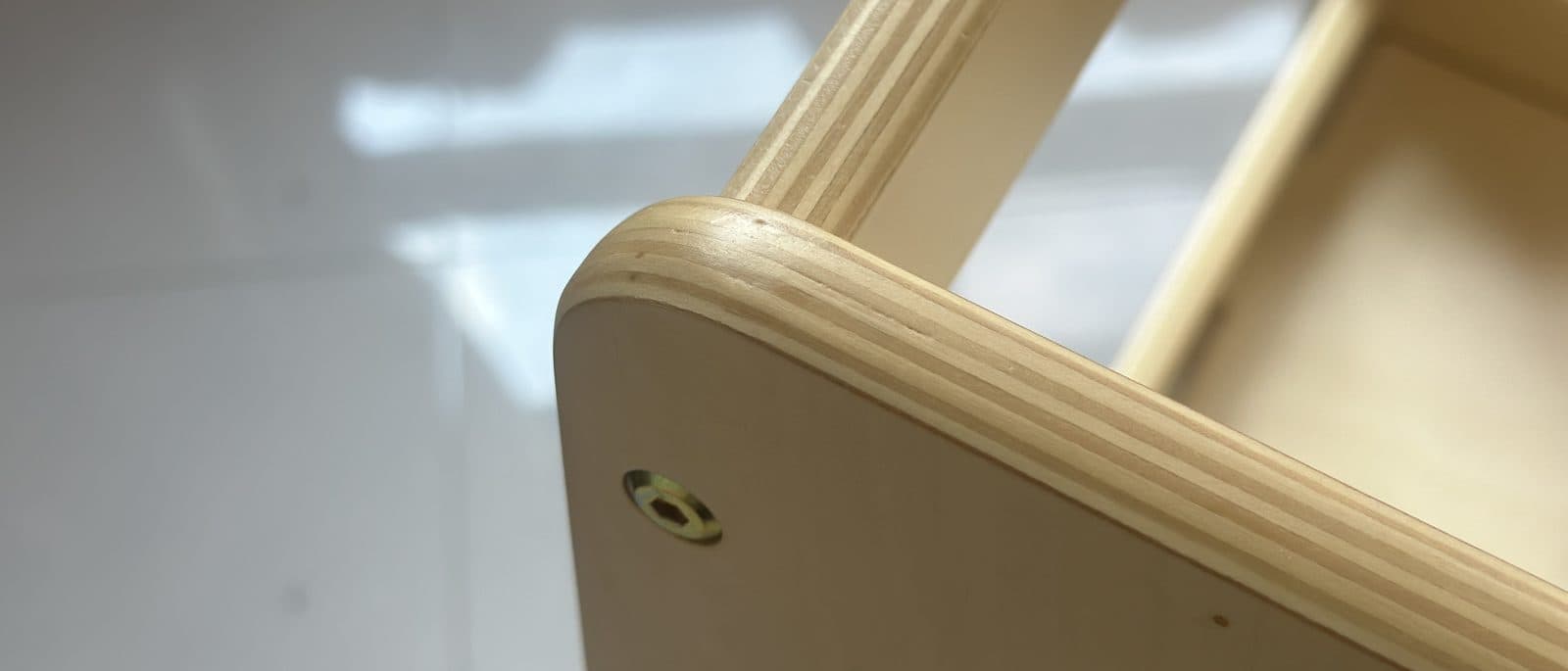
Reviewed 6 October 2026: plywood-report scope, emission-limit comparisons and product-testing checks.
When a childcare centre, preschool, or Montessori school sources furniture, the material decision quietly settles three things at once: how safe the air in the room is, how long the furniture survives daily use, and how much it costs to replace. Most product pages tell you a material is "eco" or "child-safe" and move on. This guide does the opposite — it lays out the honest trade-offs of the three materials you'll actually be choosing between, including where each one is the wrong answer.
We make wood-only children's furniture, so we have a view. But the useful version of this guide is the one that tells you when MDF is fine and when solid wood is overkill — so that's what this is.
One boundary worth stating plainly: we build with two materials, birch plywood and solid beech. No MDF, no particleboard. This guide gives MDF as much room as it does because you can't make an informed material decision without understanding it, not because we sell it.
The three materials, honestly compared
MDF (medium-density fibreboard)
MDF is wood fibre bonded with resin and pressed into a smooth, uniform panel, then surfaced with a veneer or melamine layer. Its strengths are real: it's cheap, perfectly flat, and takes a printed or laminated finish cleanly. For a low-cost cabinet in a dry, low-impact setting, it does the job.
The trade-offs matter more in a room full of children:
- It carries a formaldehyde substrate. The core is held together with urea-formaldehyde resin. Even at the lowest compliant grades, that resin is in the board — which is not true of solid wood at all.
- It must be edge-banded — and that has consequences. Because MDF is a faced product, every cut edge has to be sealed with an edge band; a raw MDF edge is both unsightly and a stronger emission point. Edge-banding seals those edges, but it doesn't remove the formaldehyde — it traps it inside the panel, so the board releases slowly over a long period rather than airing out and being done.
- Banded edges can't be rounded. Edge-banding is a press-on process, not a sanding process — so banded corners stay square. You cannot sand an MDF panel to a soft, rounded child-contact corner the way you can with solid timber or plywood. (More on why that matters below.)
- It fails at the corner on impact. A square, banded MDF corner is the weak point. One knock — and in a toddler room there will be knocks — chips the band, which simultaneously exposes a raw emitting edge and leaves a damaged, sharp corner.
- It delaminates when wet. Spills and mopping are a fact of life in early-learning rooms. MDF swells and de-laminates where solid materials simply dry out.
Verdict: acceptable for budget, dry, low-impact furniture with a short expected life. A poor fit for high-traffic, high-contact, frequently-cleaned classroom use.
Birch plywood
Plywood is thin veneers cross-laminated under pressure. That cross-grain structure gives it excellent screw-holding and dimensional stability, and a quality 13-ply birch panel is strong without being heavy. Check the formaldehyde report for the selected panel; construction alone does not establish its emission result. Plywood can be sanded and rounded like solid wood.
This is why plywood is the right answer for storage, shelving, and lockers: large flat panels, lots of screwed joints, and child-height edges that need to be rounded.
For reference, the displayed SHST report dated 31 March 2026 records a 0.039 ppm average for uncoated 18 mm, 13-ply HWPW-VC samples, with the wood species listed as birch. It uses ASTM D6007-22 and compares the result with a 0.05 ppm limit. Match the sample specification and material batch to your order; this is not a test of the finished furniture or of every plywood option.
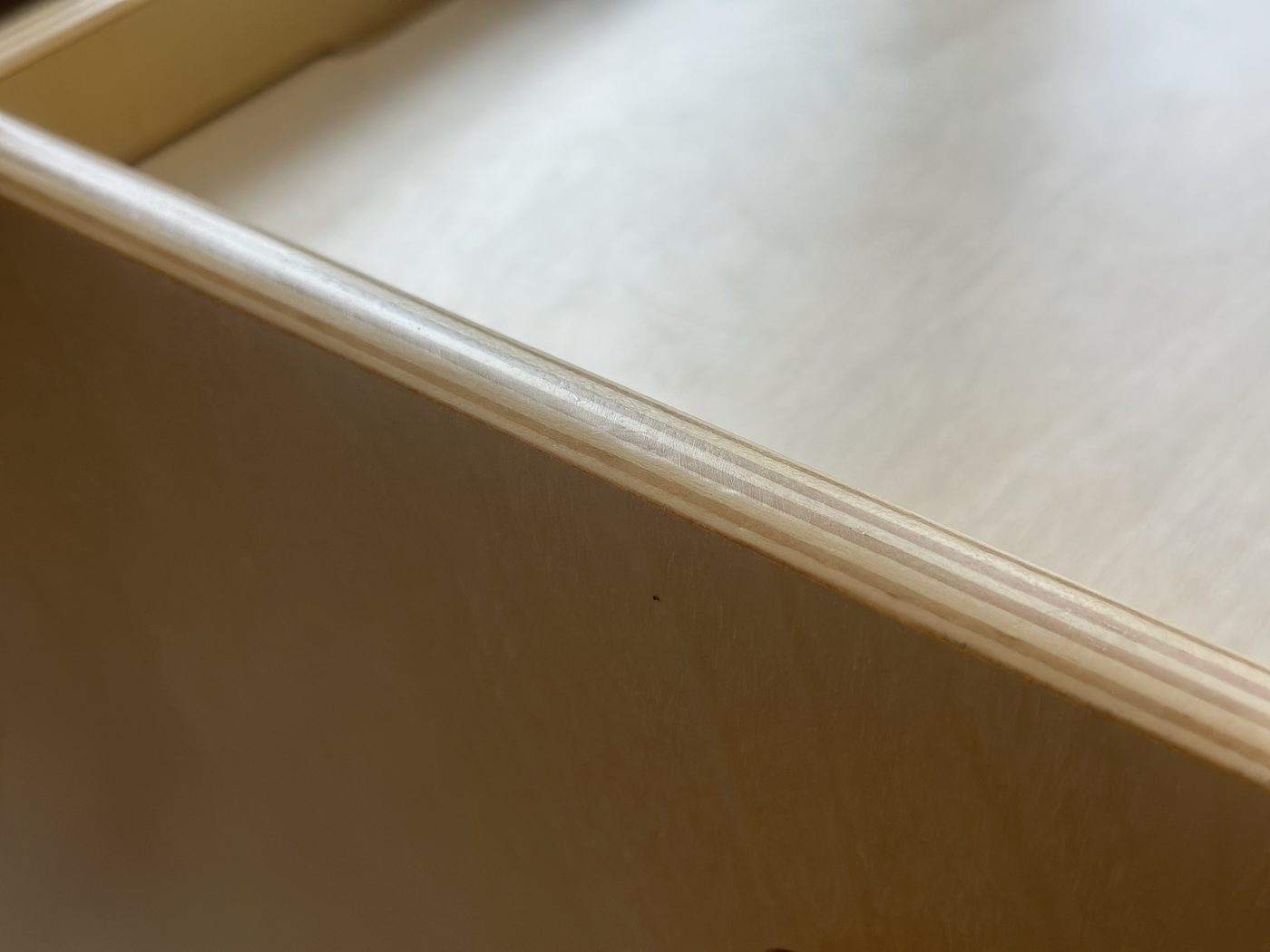 Birch plywood is built from thin veneers cross-laminated under pressure — the exposed edge can be sanded and rounded, not just banded over.
Solid beech
Solid beech is exactly that — no substrate, no resin core, no veneer. It's the strongest of the three, it can be sanded and refinished for the entire life of the piece, and it carries no engineered-panel emission question at all. The cost is weight and price.
That makes solid beech the right answer for load-bearing, high-wear items — tables and chairs — where strength and refinish-ability earn their premium, and the wrong answer for a large flat storage panel where plywood does the same job lighter and cheaper.
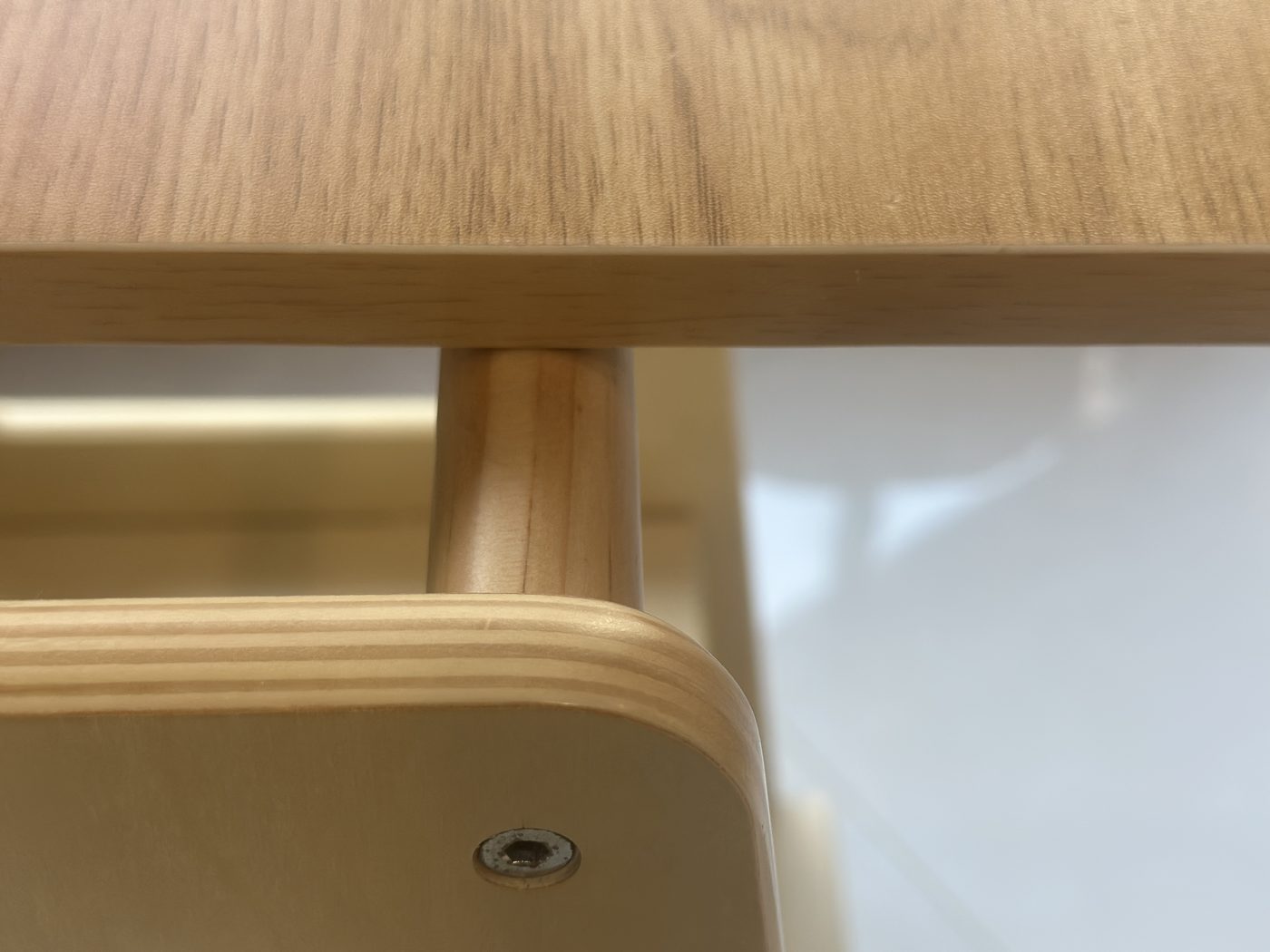 A children's table from below: a turned solid-timber leg and a birch plywood support panel with sanded, rounded corners — each material doing the job it's best at.
Compare results against the right panel limit
Formaldehyde emission limits depend on the panel category. Keep the limit separate from a particular product's measured result.
Under CARB Phase 2 (and the identical US federal TSCA Title VI standard):
- Hardwood plywood: 0.05 ppm
- Particleboard: 0.09 ppm
- MDF: 0.11 ppm
- Thin MDF: 0.13 ppm
These are regulatory limits, not measurements of two competing products. Comparing the MDF ceiling with a tested plywood value does not establish which finished product emits less in use or predict exposure in a classroom.
This is why a number beats a label. Ask for the actual tested figure, not the compliance sticker.
The edge-banding problem nobody talks about — and why it's a safety issue
Children's furniture standards care a great deal about corners and edges, because a child's eye-line and a child's fall both land at corner height. The accepted answer is a rounded, sanded corner — on our own storage line that means a 30 mm radius (R30) or larger on every child-contact corner.
Here's the part that ties back to material: you can only round a corner you can sand. Solid beech and plywood are sanded as standard, so the corner can be radiused, smoothed, and finished. An edge-banded MDF panel is not sanded — the band is pressed on and the corner stays square. And as noted above, the first knock that chips that band turns a square corner into a broken, sharp one.
So "rounded child-safe corners" and "MDF construction" are, in practice, in tension. It's not marketing — it's how the two processes physically work.
Where the AU/NZ standards fit
If you're buying for an Australian or New Zealand setting, the material conversation connects to a family of standards worth asking your supplier about by name:
- AS/NZS ISO 8124 — toy safety. Confirm product classification before using it in a furniture test plan.
- AS/NZS 1859 / 4266 — the emission and test-method standards behind the E0 / E1 classes for reconstituted boards: particleboard and dry-process fibreboard (MDF).
- AS/NZS 2269 — structural plywood, with its own Super E0 / E0 / E1 emission classes. This is the one that applies to plywood, not the 1859 series.
- AS/NZS 4610 — a school-furniture series; confirm the relevant part and product scope with the testing laboratory.
A supplier who can map their material to these — rather than just saying "AU compliant" — is a supplier who has actually read them.
Quick decision guide
| If you need… | Best material | Avoid |
|---|---|---|
| Storage, shelving, lockers (large panels, rounded edges) | Birch plywood | Square-edged MDF in a toddler room |
| Tables and chairs (load-bearing, long life, refinishable) | Solid beech | Fibreboard tops on high-wear surfaces |
| Lowest upfront cost, dry & low-impact use, short life | MDF (eyes open) | — |
| A frequently-cleaned, spill-prone room | Plywood or solid wood | MDF (delaminates when wet) |
| Comparing formaldehyde evidence | Match each material to its own report, method and applicable limit | Ranking actual products by different regulatory ceilings |
How to actually verify a supplier's material claims
You don't need to take any of the above — or any supplier's word — on trust. Three questions separate a real material chain from a brochure:
- "What does the panel report record — method, result, unit and applicable limit?" Match its date and sample description to the selected material.
- "Which test evidence applies to this model and material batch?" Check the sample identification and its link to the order. If new testing is needed, agree its scope, laboratory, report addressee, cost and timing in the quotation.
- "How are the child-contact corners finished?" If the honest answer is "edge-banded," you now know what that implies for both emissions and impact safety.
That's the whole method. Verifiable beats claimed, every time — which is also, not coincidentally, exactly how we'd want you to check us.
Frequently asked questions
Is MDF safe for children's furniture? MDF and plywood have different panel emission limits. Those limits alone do not establish the safety of a furniture model. Review the actual material result together with the finish, edge treatment, assembled construction and requirements for the intended use.
Is plywood or solid wood better for classroom furniture? Different jobs. Birch plywood is better for storage and shelving — strong, stable, lighter, and lower-cost across large panels. Solid beech is better for tables and chairs, where load-bearing strength and the ability to refinish for the life of the piece justify the higher weight and price.
Does "CARB Phase 2 compliant" mean low formaldehyde? The limit depends on panel type: hardwood plywood and MDF have different limits. Check the applicable certification and actual sample result, including the method and date, then match the evidence to the quoted material. A panel claim does not by itself establish room-air exposure.
MJK Furniture is a wood-only children's furniture manufacturer in Xuzhou, China, supplying childcare centres, preschools, and Montessori schools in Australia, New Zealand, and worldwide. See our storage & shelves and tables & chairs ranges, or the full materials & certification framework.