Reviewed 6 October 2026: model configuration, Australian toppling-furniture guidance, and plywood-report scope.
Put a standard library bookcase next to a Montessori shelf and the difference looks trivial — one simply holds more books per shelf. Spend an afternoon in a 3-to-6 classroom and that "trivial" difference turns out to be the entire point. A Montessori shelf isn't a smaller bookcase. It's a piece of furniture designed so a four-year-old can choose a book, take it, and put it back without asking an adult for help.
That single design goal — child independence — is what separates a Montessori shelf from a shelf that happens to be short.
What actually makes a shelf "Montessori"?
Three things, and none of them are decoration:
Child-height. The top shelf sits at roughly 73.6 cm — low enough that a standing preschooler reaches it without a stool. If a child needs an adult to fetch a book, the shelf has already failed its job.
Front-facing. Books face cover-out, not spine-out (more on why below).
Open display. Books remain visible and accessible from the display side. Rear-panel and tabletop configurations vary by model and should be confirmed before ordering.
Why cover-out instead of spine-out?
A six-year-old who can read will scan spines like an adult. A three-year-old can't — they recognise a book by its cover picture. Spine-out shelving quietly locks the youngest children out of choosing for themselves. Cover-out display puts the choice back in their hands.
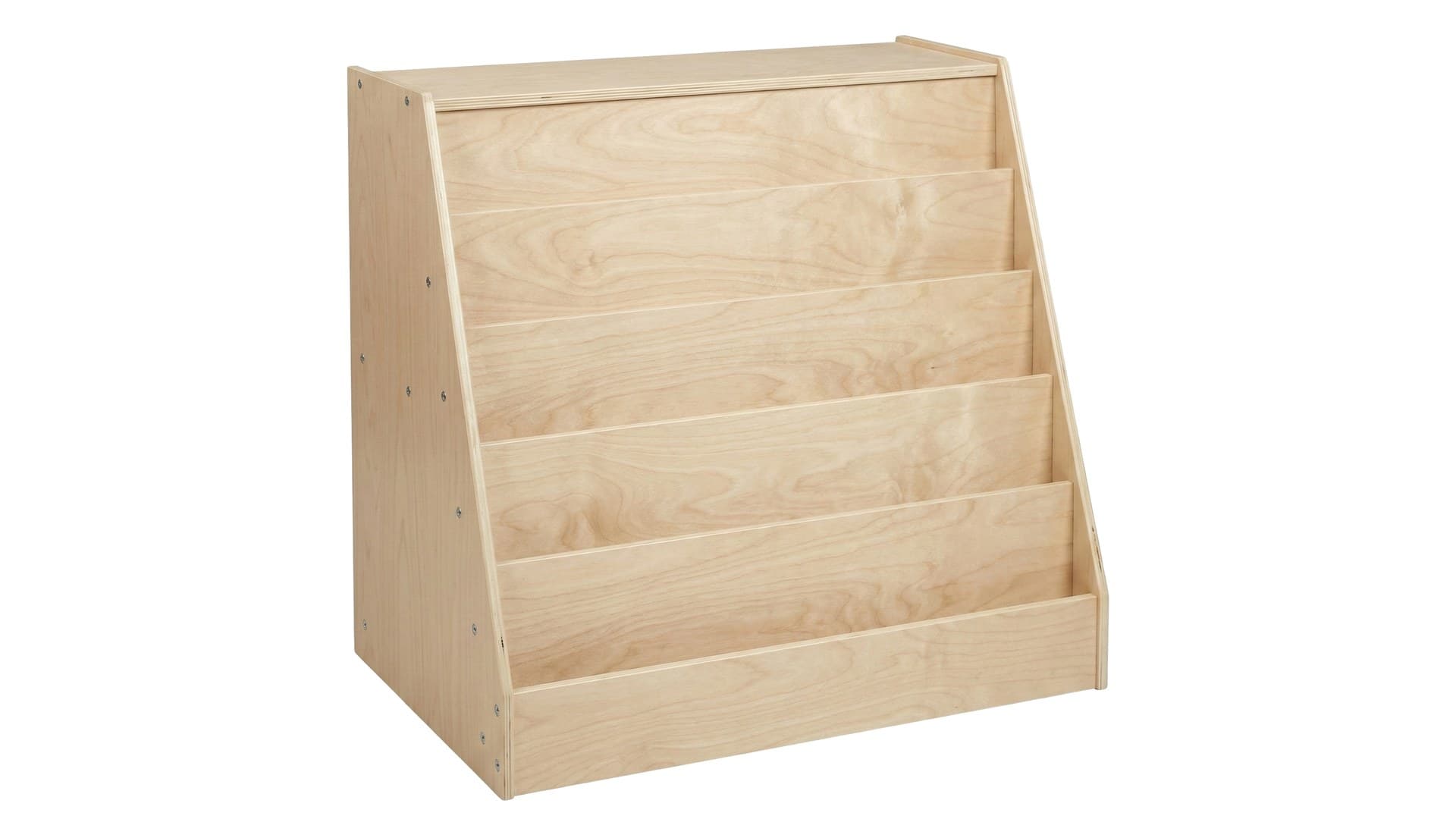
That's why the BS-104's shelves are angled, not flat: a 10° tilt holds each book upright with its cover showing, while still letting a small hand pull it free without the whole row toppling.
Walk through classrooms in different countries and you'll find shelves in every shape imaginable. Yet for a child still new to the world and full of curiosity, a front-facing shelf is the most fitting of them all. It was that curiosity that called this kind of shelf into being. In the end, it wasn't the child who chose the shelf — it was the shelf that chose the curious child.
Confirm the rear configuration and overall dimensions
For a wholesale range, front-facing display and the rear configuration are separate specifications. BS-103 and BS-104 have the same confirmed width and height but different depths; the deeper version has a rear tabletop. Request model-labelled side and rear photographs or a drawing before listing a particular version as open-back, double-sided or suitable for a rear work surface.
Both models are 73.6 cm high and 76.2 cm wide, with five tiers of front-facing display. Confirm the model depth before ordering. Each tier carries up to 20 kg.
For a custom depth or rear-panel configuration, share the required dimensions and arrangement for review. Confirm the agreed specification before ordering.
The safety question every childcare buyer asks
Montessori education sets out to grow a child's independence. But a young child hasn't yet learned to weigh risk, and we shouldn't ask a child still making sense of the world to gamble with their own safety. This is the moment a low, stable shelf matters most — not as a limit placed on the child, but as the very thing that lets the Montessori idea carry on, undisturbed by an accident no one ever wanted.
A low centre of gravity is the first line of defence: a 73.6 cm shelf is far harder to tip than a tall bookcase. Solid side panels and an anti-tip wall strap come standard.
For Australian orders, the Consumer Goods (Toppling Furniture) Information Standard 2024 has applied since 4 May 2025. Its coverage includes bookcases at least 686 mm tall that fall within its consumer-goods scope. Covered furniture needs permanent product warnings, point-of-sale warnings (including online), and safety information in supplied instructions. An included wall strap does not, on its own, establish compliance. Confirm the model's classification, warning artwork and installation instructions for your order. See the ACCC guidance and our guide to Australian furniture safety standards.
What it's made of
The shelf is built from plywood — 15 mm or 18 mm, your choice — and finished in either hardwax oil or a sprayed clear lacquer. Edges and corners are rounded, because a shelf at a toddler's eye level can't have a sharp arris anywhere a child might walk into it.
Rounding an edge sounds like one step. It isn't. We first run a router with a corner bit to cut the timber to the radius we want. Straight off the router the surface still isn't smooth, so it goes back under an angle grinder loaded with 120-grit paper. Then — the part no machine does for us — someone takes 240-grit by hand and works each piece, edge by edge, until nothing at a child's height can catch them.
For material evidence, the SHST report dated 31 March 2026 records a 0.039 ppm average for uncoated 18 mm, 13-ply HWPW-VC samples, with the wood species listed as birch. Report HJ-QAT-260457 uses ASTM D6007-22 and compares the result with a 0.05 ppm limit. It does not establish an E0 grade or cover the assembled shelf and its finish. Match the quoted panel and material batch to the evidence; confirm the required scope for a 15 mm or custom selection. Our board-material comparison covers related buying questions, and the materials and certification page shows the report and verification steps.
Quick answers
What is a Montessori bookshelf? A low, open shelf that displays books cover-out at a child's height, so children aged roughly 3–6 can choose, take, and return books independently. The defining feature is front-facing display, not size.
What height should a Montessori shelf be? Low enough for a standing child to reach the top tier without help. The BS-104 stands 73.6 cm tall for exactly this reason.
Why are Montessori shelves front-facing? Young children who can't yet read identify books by the cover image. Cover-out display lets them choose for themselves; spine-out shelving doesn't.
Are Montessori shelves safe for daycare and childcare centres? Assess stability, the assembled configuration, installation instructions and anchoring for the selected model. A supplied anti-tip strap is one part of that review, not proof of compliance with Australia's Toppling Furniture Information Standard. Importers and distributors should also check the required product, online-sale and instruction-manual warnings.