Reviewed 6 October 2026: plywood-report date, sample description and core-specification scope.
When a supplier quotes you "birch plywood," it's easy to assume you know what you're buying. In practice, those two words tell you almost nothing.
"Birch plywood" is a family name, not a single material. Under it sit three independent variables — the core, the origin, and the face grade — and each one can make two boards labelled "birch plywood" behave completely differently in strength, appearance, compliance, and price. A spotless-looking quote could be premium imported all-birch, or a poplar core under one thin sheet of birch veneer with other species hidden inside.
Here are the three questions to ask of any "birch plywood" quote — and how we answer each.
Question 1 — What is the core, really?
The birch in "birch plywood" is often only the outermost layer. Inside, the core can be solid birch, or a lighter, cheaper poplar.
One fact gets misunderstood here: the formaldehyde in plywood comes from the glue, not the core. So a poplar core can still reach a very low emission level — if the right adhesive is used.
We put our choice on the table:
- Our default quote is a poplar core with a birch face. This is a deliberate cost-to-performance decision, not a quiet downgrade — it is lighter, better value, and well within what indoor early-learning furniture needs.
- We also make full imported birch core (Russian or European) when a project needs higher structural strength or a more premium look.
- The displayed SHST report dated 31 March 2026 records a 0.039 ppm average for uncoated 18 mm, 13-ply HWPW-VC samples, using ASTM D6007-22 against a 0.05 ppm comparison limit. The sample page lists birch but does not identify the core and face separately. Report HJ-QAT-260457 therefore does not establish that this exact poplar-core specification was tested; confirm the quoted construction and material-batch linkage.
For the full comparison of plywood against MDF and solid wood, see our breakdown here. The displayed report and checks for its applicability to an order are on our materials & certification page.
What to ask: Is the core solid birch or a veneered poplar core? And which board does the formaldehyde report actually correspond to?
Question 2 — Where is the birch from?
Most quotes never mention this, and it can decide whether you can legally bring the goods in at all.
Birch comes mainly from two regions: Russia and Europe. Russian birch was long the cheaper default. But since 2022, FSC has suspended and withdrawn all certificates in Russia and Belarus, and blocked the sourcing of any controlled forest products from both countries — meaning Russian timber can no longer enter FSC products anywhere in the world. PEFC has classified the same material as "conflict timber."
The practical consequence is simple: if you need FSC-certified birch, or you sell into a market with requirements on timber origin, Russian birch is off the table — it has to be European.
We import from both Russia and Europe, so we can match the origin to your target market and compliance needs: European where FSC or market rules require it, Russian where they don't and value matters. This is a real procurement trap, and we'd rather stand in front of it for you.
What to ask: Where is this birch from? If I need FSC certification or sell into a regulated market, does the source you're offering actually qualify?
Question 3 — Which face grade?
Birch faces are graded too, and the difference is mostly appearance. In the Chinese mills this runs on two informal grades — "pure white" and "ordinary white" — that have no clean English equivalent, which is part of the point: buyers abroad often can't see what they're being sold.
- Ordinary white is the standard natural birch face: more colour variation, small knots, the dark "water lines" birch is known for, and the occasional patch. It usually has to be edge-banded to cover an edge that isn't clean enough on its own, and it doesn't meet the appearance standard we hold for early-learning furniture.
- Pure white is a high, uniform white achieved through a bleaching process. The difference is purely cosmetic — it does not change the structure.
We use pure white. And we'll say it plainly: that white comes from a bleaching process, for a uniform, clean appearance. To be precise — bleaching only treats the surface look of the face veneer. It does not touch the formaldehyde story above, which is about the glue, not the bleach.
What to ask: Is this a pure-white or an ordinary-white face? If it's ordinary white, is it being edge-banded to hide the edge?
The three questions meet at one edge
Follow all three questions and they arrive at the same place: the edge.
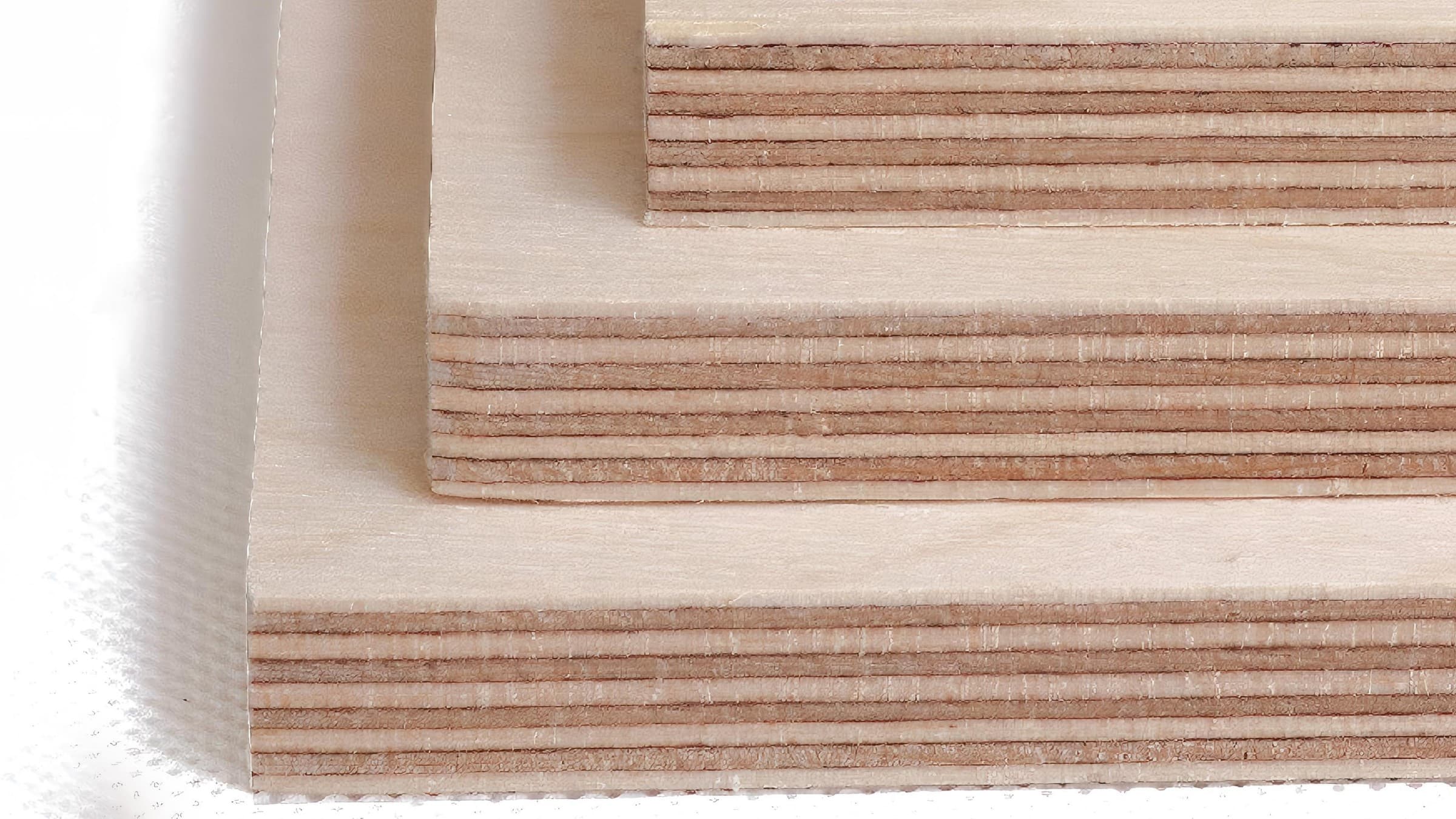
Our furniture is deliberately left unbanded. The natural layered side of the plywood is exposed, finished only with hardwax oil or clear lacquer. This isn't to save a step. It's because only an exposed solid edge can be sanded into a true, curved safety corner. An edge-banded board can't — the banding strip sits on a square edge, and the moment you round it into a real radius, the strip is cut through. Rounded corners are one of the hardest safety requirements for early-learning furniture.
So the chain is closed: a clean pure-white face lets us leave the edge unbanded; an unbanded edge can be sanded into the curved corners a child needs; and a clear lacquer finish handles the moisture an exposed edge would otherwise face.
That edge does a second job, too: it's your inspection window. With the edge exposed, you can see the core, count the plies, and check that nothing has been substituted inside. We can leave it open because what's inside holds up to being looked at.
One honest trade-off: an exposed edge does need a little more care than a banded one — banding is tougher against long-term knocks and damp. Our answer is the quality of the pure-white face plus the clear lacquer, and the fact that this is built for indoor early-learning rooms. And if your project needs edge-banding, we can do it — we have the machine. We leave edges unbanded by default because we think the safer corner matters more, not because we can't band.
You'll find the rounded, banding-free edges across our classroom tables and chairs and storage and shelving.
Why we tell you all this
"Birch plywood" can be used to hide a lot. We've chosen to do the opposite: lay out every variable under the name — core, origin, face — say plainly what we choose and where the trade-offs sit, and leave the edge exposed so you can check for yourself.
We don't pretend our board is solid birch, or that the white face is natural. We tell you what it really is, why we chose it, and where the trade-offs sit.
That's how we work. The edge we deliberately leave open is both the child's safety and your window to verify it.
Want to review the displayed plywood report (HJ-QAT-260457) against your quoted specification, or discuss which documents your project needs? Get in touch.