Reviewed 1 October 2026: production timing, packing checks and Australian import guidance.
The second problem — and I raised it first
The companion article was about the plastic connector inserts an Australian buyer sent me.
But that conversation had a second problem in it — and this time I was the one who named it, not him.
I looked at the photos and wrote back. My concern was that the previous factory had shipped before the paint had fully cured, leaving the finish vulnerable to heat in the container.
He replied — that's correct.
Then he added that the shipment had cost them a sale.
That conversation is why I ask about curing and packing before discussing a loading date. Photos alone cannot establish every cause of transit damage, but they can tell us which production records and packing details to check.
One — the journey includes yards and trucks, not just the sea
A container shipment includes factory loading, road transport, waiting in yards, the sea crossing and handling after arrival. The conditions change along that route.
ISTA's guidance on ocean shipments identifies temperature and humidity, shifting goods, stacking pressure and loading or unloading shocks as potential hazards. It also discusses research in which the highest temperatures occurred while containers were stationary at dry docks, rather than at sea.
For an importer, the useful question is whether the finish and packaging are ready for the whole journey. A particular temperature measured on another route is not a forecast for your order.
We can control preparation in the factory. The packing method, handling, route and conditions in transit also affect what arrives at your warehouse.
Two — what happens when the paint hasn't cured
A finish can be dry to the touch before it is ready for packing. The required curing time depends on the finish and the workshop conditions.
If panels are stacked before the finish is ready:
- Contact areas can stick together.
- Separating the panels can leave surface marks.
- Appearance defects can make otherwise usable stock difficult to sell.
Rushing that stage creates a risk before the shipment leaves the factory. A clean-looking pre-shipment photo does not, by itself, confirm that the finish is ready to be packed.
Three — our practice: allow about a week for curing
After spraying, we typically allow about a week for curing before packing and loading. We do not treat a dry-looking surface as a reason to shorten that allowance.
Our normal production window is 30–45 days after deposit clearance, including about one week for finish curing. Shipping time is additional. Confirm the schedule for your order before promising a delivery date to your own customers.
This is one of the steps we take to reduce the risk of finish damage in transit.
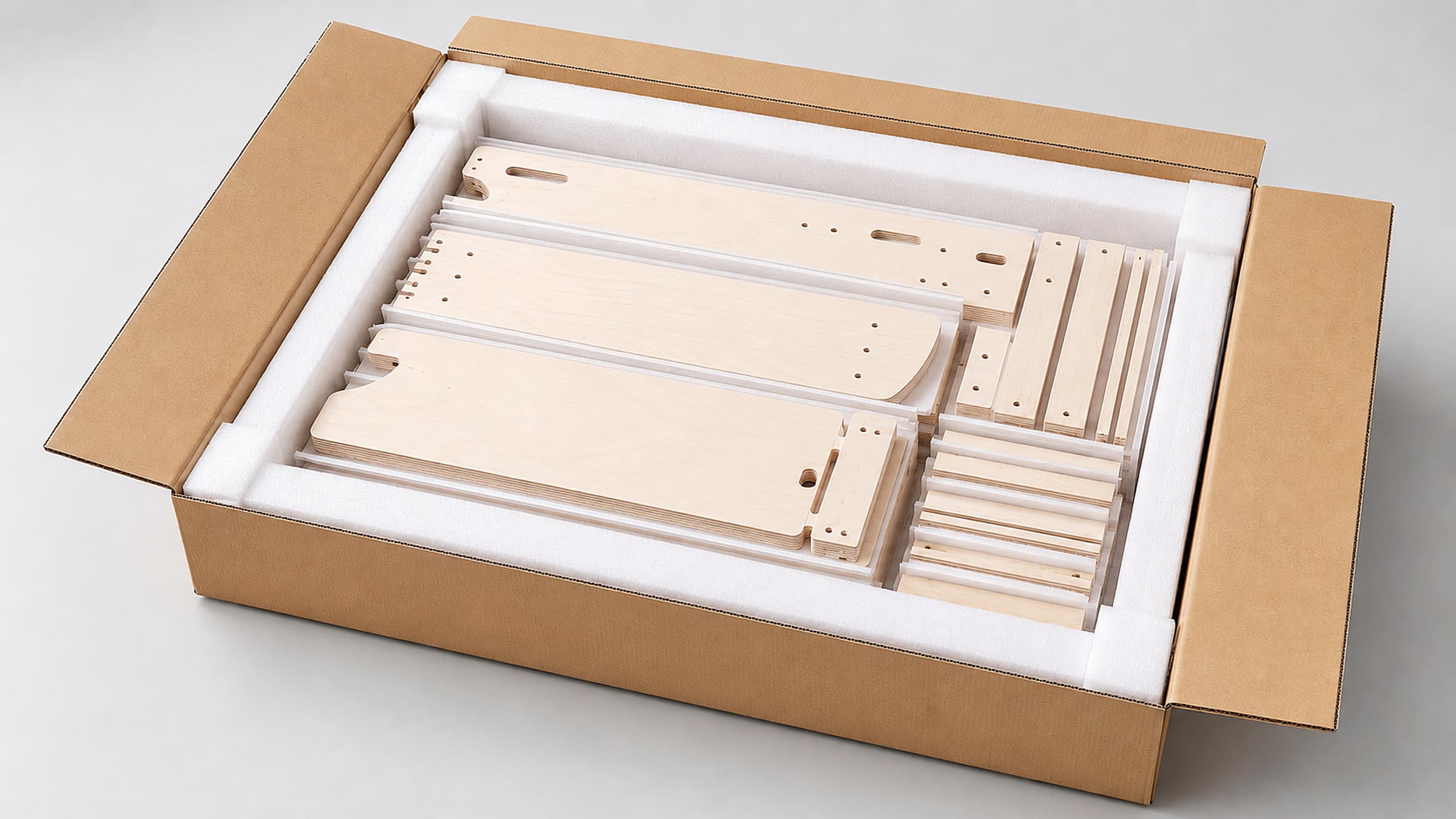
Four — a layer of EPE foam between every two panels
Flat-pack (KD) means a piece travels as a set of panels stacked together — a storage shelf unit, for instance, is mostly large flat panels. Panel-to-panel rubbing is one source of transit wear that the packing needs to address.
Our practice: a layer of EPE foam between every two panels.
Not just the four corners. Not just the outer wrap. Between every layer.
The carton is corrugated board, and a rigid EPS foam frame goes around the edges. The EPE separates the panel surfaces to reduce rubbing; the EPS frame cushions the edges against impact.
It costs material and packing time. For a wholesaler or distributor, a damaged panel can mean a replacement request, a delayed sale or a return. That is why the packing specification belongs in the order discussion.
Five — what to check before a wholesale shipment is boxed
Curing time is difficult to judge from a product photo. The protective layers are hidden once the carton is sealed. Both are easier to check before loading.
For an importer, wholesaler or distributor, I suggest agreeing these four points with the supplier:
- Packing specification: confirm the version for each model and ask for photos of a representative open carton, showing the panel separators, edge protection and hardware packs.
- Carton data: confirm units per carton, outer dimensions, gross weight and carton count. If pallets are used, confirm the loaded pallet dimensions and weight separately before the forwarder prices the shipment.
- Inspection record: agree what will be checked before packing, including finish readiness, visible surfaces and parts against the approved specification. Keep the dated inspection record and packing photos with the order.
- Documents and charges: confirm the packing list and ask the broker or forwarder which declarations or treatment evidence apply to the actual goods and packaging. Ask the quote to identify any treatment, inspection or destination handling charges and who pays them.
Use our wholesale procurement checklist to put those details beside your SKU quantities and cost comparison.
We welcome the check. We respond to video-tour requests within 24 hours. Tour timing is subject to operating hours and the production schedule; please share your preferred local business-hour window. Ask to see the finishing and packing areas when you contact us. More on how we run the business.
Frequently asked questions
How long do you allow for curing? Typically about a week after spraying. This is included in our normal 30–45 day production window after deposit clearance. Shipping time is additional; the order schedule should be confirmed before booking freight.
Is there EPE foam between every two panels? Yes — between every layer, not just the corners. The carton is corrugated board with a rigid EPS foam frame around the edges as well. Confirm the packing specification for the models in your order.
What finish do you use? Two options, buyer's choice: a water-based lacquer or a hardwax oil. They price differently. Details on the materials and certification page.
Does all timber furniture sent to Australia need fumigation? Do not assume one treatment applies to every order. Check the furniture's materials and construction against the relevant BICON conditions, and assess its pallets, crates and dunnage separately. See DAFF's timber product categories.
For shipping packaging, ISPM 15 concerns raw wood. Heat treatment and fumigation are different methods. Packaging made wholly from qualifying processed wood, such as plywood made using glue, heat or pressure, is exempt from ISPM 15; solid-wood runners or blocks need separate consideration. Packaging must still be free of biosecurity contamination. See DAFF's ISPM 15 guidance and our Australian import guide for the checks to discuss with your broker.
Which port will my order ship from? Confirm the departure port and route in the quotation and freight booking. The choice depends on the order, the applicable treatment arrangements and the forwarder's service. An Australian destination alone does not determine a fixed departure port. More in our lead-time breakdown.
Can I see the goods before they're boxed? Request a WhatsApp video check while planning the inspection and packing schedule. We respond within 24 hours; the visit time and what can be shown depend on operating hours and the order's production stage.