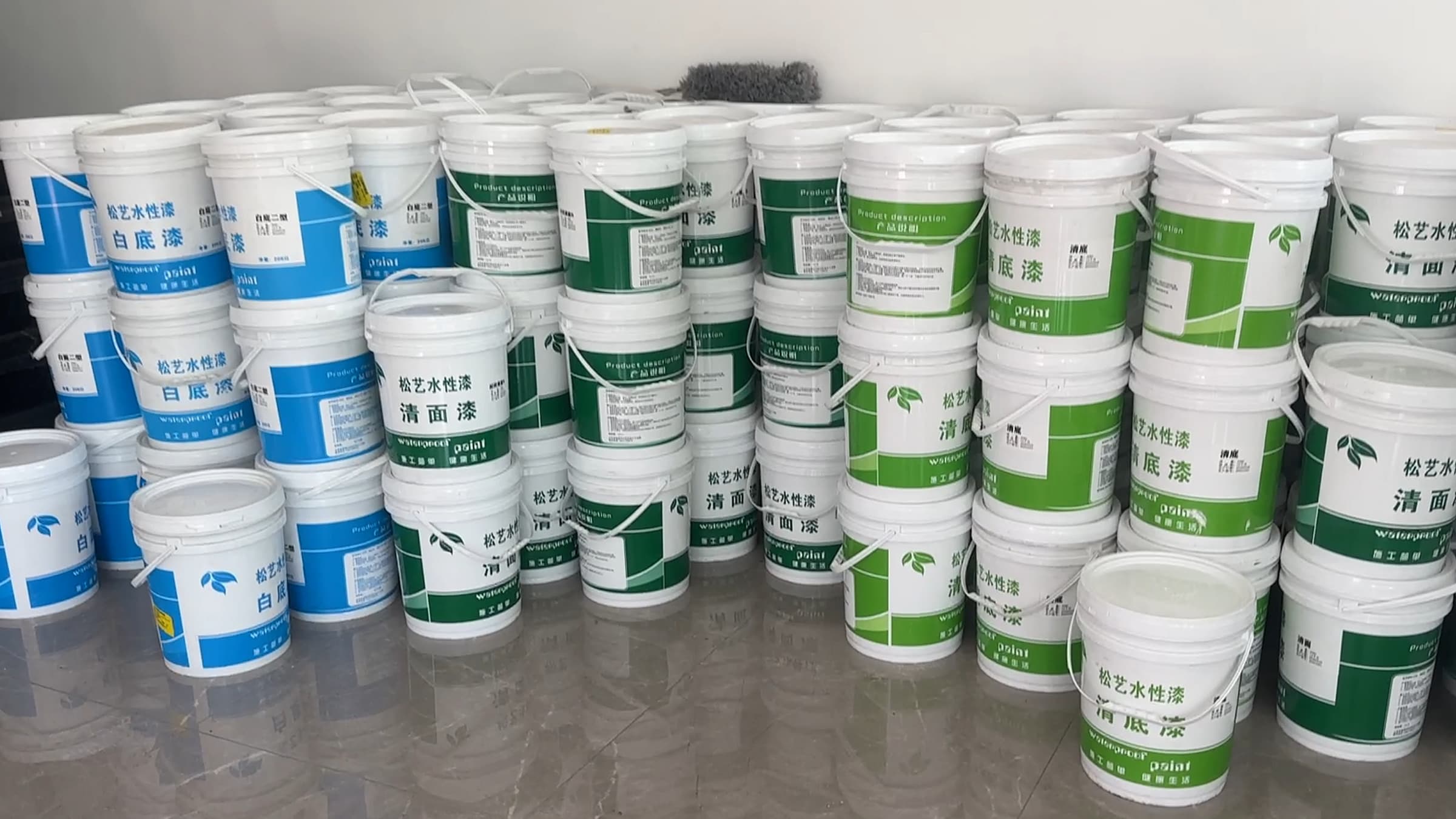
The short answer
For children's furniture we use a water-based finish — not the hardest, most durable, or easiest-to-apply option, but the safest and lowest-emission one. That is a deliberate trade-off, and we make it because the end user is a child. This is the comparison we actually ran to get there, including the parts where water-based finish is the weaker choice.
Three options, one hard constraint
For batch-finishing children's furniture there are three mainstream choices: hardwax oil, oil-based paint, and water-based finish. With children as the end user, low emissions and safety are a hard constraint, not a bonus feature. We chose by comparing them, not by defaulting to whatever is easiest.
Why we ruled out hardwax oil first
Hardwax oil is an excellent natural hand-applied finish, and if a buyer specifically wants it, we can do it. But it is wiped on piece by piece by hand, which pushes the unit price up noticeably on large-volume orders. For big B2B orders it simply is not the optimal answer — so we keep it as an option a buyer can choose, and the reason we set it aside by default is scale cost, not quality.
Oil-based versus water-based — the honest trade-offs
Here is where we put our cards on the table, including the parts that don't flatter our own choice.
Oil-based paint has real advantages: higher film hardness, better heat resistance, and stable film formation. It is technically the easier finish to apply, and it holds up in a hot spray booth in summer without much trouble.
Water-based finish has genuine drawbacks we are not going to hide. The cured film is softer than oil-based, and it is less heat-resistant. And in a hot summer spray booth, if the booth temperature runs too high, water-based finish can fail to form a proper film — the water flashes off too fast — and the piece can be ruined.
Water-based finish also has one decisive advantage: it is low-VOC, and it meets strict children's-furniture safety and environmental requirements.
So the conclusion writes itself. Faced with the hard constraint of "a child will use this," low emissions outweigh everything else. We choose water-based even knowing it is the harder finish to get right.
So how do we make water-based match oil-based?
This is where process becomes the proof. To get a water-based finish that rivals oil-based, we do three things:
- We ventilate and control the spray-booth environment.
- We spray in the cooler early morning, which avoids the high-temperature film-forming problem entirely.
- We build hardness by adding an extra top coat — two primer coats plus two top coats.
The result is a water-based surface that stands up in daily classroom and childcare use — on everything from storage to our solid beech tables and chairs — while holding the environmental line that oil-based can't.
Why this matters even though you can't see it
Many factories default to oil-based paint because it is harder-wearing and easier to spray — it saves time and money. We take the harder road because the end user is a child. It is a choice a buyer may never see on the surface of the finished piece, but it is exactly the kind of decision that separates furniture built for children from furniture built to a price. It sits alongside the other material choices we make, from why we use plywood and solid wood rather than MDF to how those choices line up with Australian childcare safety standards, all resting on the birch plywood underneath.
You'll find the finish alongside our other material and safety documentation on the materials and certification page — and if you want to talk through the right finish for your order, get in touch.
Frequently asked questions
What finish do you use on children's furniture?
A water-based, low-VOC finish that meets strict children's-furniture safety and environmental standards. We also offer a hardwax oil hand-finish if a buyer prefers it.
Oil-based paint is harder and more durable — why not use it?
Technically it is easier to apply and more hard-wearing, but its emissions do not meet children's-furniture safety standards, so we do not use it on children's products.
Water-based finish is softer — how do you keep it durable?
With process: two primer coats and two top coats, plus temperature-controlled spraying, so the hardness and the finish rival oil-based.
How do I choose between hardwax oil and water-based?
Hardwax oil is a natural hand-applied texture at a higher unit price — it is hand-wiped, so cost rises at volume. Water-based suits large volumes and is better value. The buyer chooses.